
Is that growing gap in your garage floor just a cosmetic eyesore, or is it a warning that the ground beneath your home is literally shifting? It’s a common concern for Leon County homeowners who watch a small hairline fracture transform into a tripping hazard after a season of heavy Florida rain. You might worry about the structural integrity of the slab under the weight of your vehicle, or feel frustrated by DIY patches that simply don’t hold up against our region’s unique geological pressures.
We understand the anxiety that comes with seeing your property’s foundation compromised. This guide is designed to help you identify the root cause of the damage and find a permanent solution for garage floor crack repair Tallahassee homeowners can trust. You’ll learn how to evaluate the severity of different cracks and why Tallahassee’s clayey soil requires specialized stabilization techniques. We will also preview advanced remedies like PolyRenewal, a lightweight and waterproof solution that fixes the problem at the source without the heavy weight of traditional mudjacking.
Key Takeaways
- Learn to distinguish between harmless cosmetic shrinkage and structural settlement cracks that threaten your home’s stability.
- Understand the unique impact of Tallahassee’s sandy-clay soil and heavy seasonal rains on your concrete slab’s foundation.
- Discover why PolyRenewal provides a more permanent solution for garage floor crack repair Tallahassee by addressing soil voids without adding excessive weight.
- Follow the professional steps required to stabilize your floor and prevent future settlement through advanced soil remediation.
- Explore the critical connection between crawl space moisture levels and the structural integrity of your garage and adjacent slabs.
Identifying Garage Floor Cracks: When to Worry
Garage floors are unique because they function as both a structural foundation and a high-traffic driveway. While a crack in a patio might be a minor annoyance, a crack in your garage is often a symptom of failing support under a heavy load. Experts like those at Born Integrated Construction understand that your garage slab must withstand the weight of vehicles, shelving, and heavy storage, making garage floor crack repair Tallahassee a priority for maintaining the safety of your home. If a floor begins to fail, it doesn’t just look bad; it can eventually compromise the surrounding walls and entry points.
Homeowners often overlook these fractures until they become undeniable. However, the health of your garage floor significantly impacts your home’s resale value. Potential buyers and home inspectors view wide floor cracks as a sign of deeper foundation instability. Addressing these issues early preserves your equity and ensures the property remains attractive to the market. A level, stable floor suggests a well-maintained home, while neglected cracks can lead to difficult negotiations during a sale.
Hairline vs. Structural Cracks
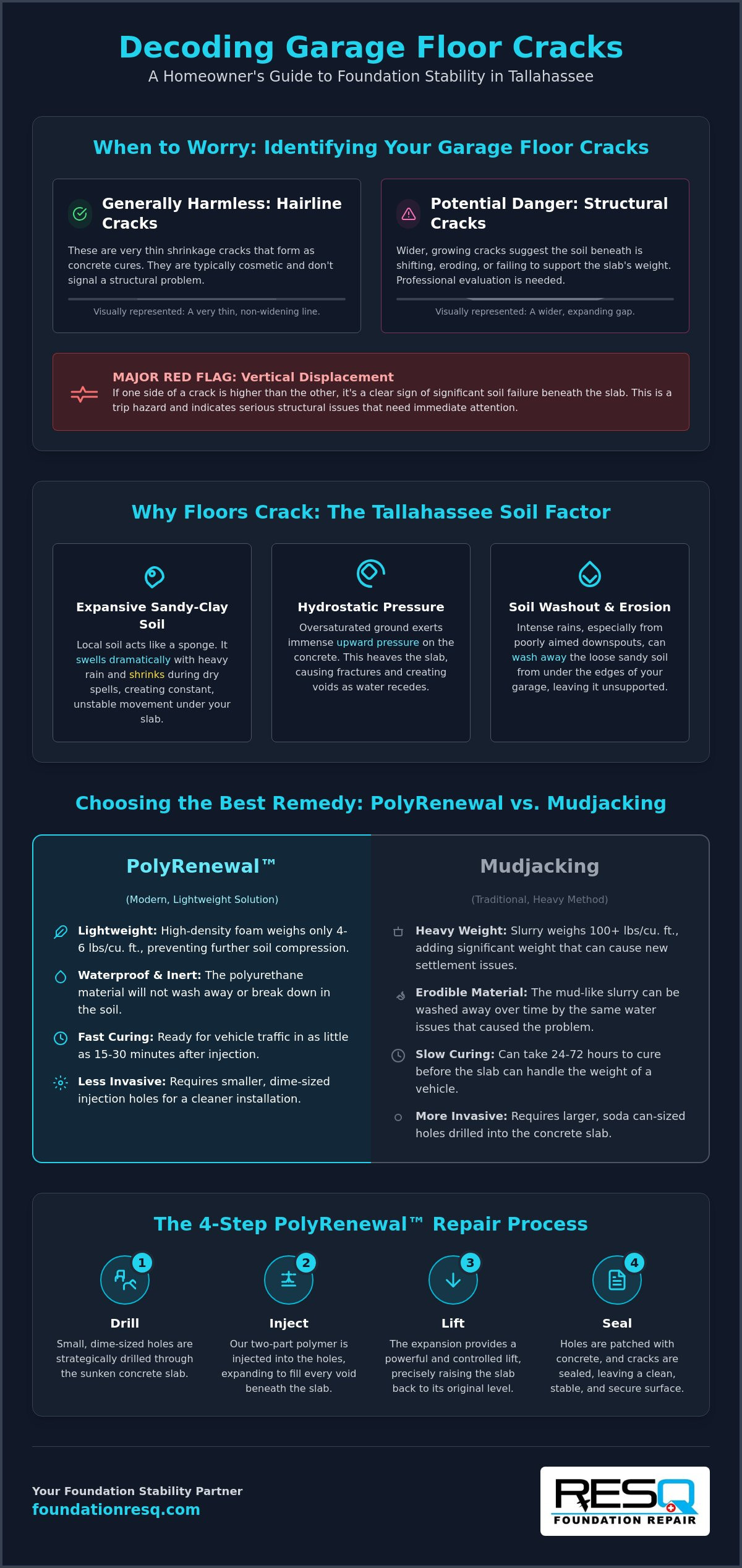
Most concrete slabs develop hairline cracks during the curing process. These are typically surface-level shrinkage cracks that don’t indicate a structural failure. In contrast, structural cracks suggest that the soil beneath the slab has shifted or eroded, leaving the concrete unsupported. You can perform a simple “coin test” to gauge the severity of the damage. If you can easily slide a quarter into the crack, it’s likely wider than the 1/8 inch threshold and requires a professional evaluation. Structural cracks often grow over time, indicating that the slab is no longer resting on a solid base.
The Danger of Vertical Displacement
Vertical displacement is one of the most serious red flags for any homeowner. This occurs when one side of the crack sinks lower than the other, creating an uneven ledge or “lip.” This isn’t just a trip hazard; it can cause repetitive stress damage to your vehicle’s tires and suspension as you drive over it every day. This symptom usually points to significant soil voids or erosion. While older methods like mudjacking were once the standard for lifting these slabs, modern homeowners now have more durable, lightweight options. If you notice these uneven edges, it’s time to investigate concrete leveling in Tallahassee to restore a flat, safe surface and protect your vehicle.
Why Garage Floors Crack: The Tallahassee Soil Factor
Tallahassee’s unique geology is the silent driver behind most structural damage in the region. Unlike the stable bedrock found in other parts of the country, our local landscape is defined by The Tallahassee Soil Factor, which involves a volatile mix of sand and highly expansive clay. This combination is particularly troublesome for concrete slabs. The clay components swell significantly when saturated by our heavy humidity and rainfall, then shrink during dry spells. This constant movement creates a “pumping” effect that eventually leads to the need for garage floor crack repair Tallahassee as the concrete struggles to adapt to the shifting ground.
Beyond simple shifting, hydrostatic pressure plays a major role in slab failure. When the ground becomes oversaturated, water trapped beneath your garage floor exerts immense upward pressure. Concrete is incredibly strong under compression but lacks flexibility. When the pressure from below exceeds the slab’s ability to resist, it heaves and fractures. This pressure often forces water through existing hairline cracks, widening them and creating empty pockets of air, or “voids,” where supportive soil used to be. Once these voids form, the slab loses the ground support it needs to hold the weight of your vehicles.
The Washout Cycle in North Florida
Our region experiences intense seasonal weather, from summer afternoon deluges to tropical systems. These events dump massive volumes of water that can quickly carry away loose sandy soil from the perimeter of your garage. This erosion process accelerates during hurricane season, leaving the edges of your slab hanging over empty space. Poorly maintained gutters or downspouts that dump water directly at the base of the garage are the primary contributors to this rapid soil loss and subsequent slab cracking.
Inadequate Soil Compaction
Many residential developments in Leon County were constructed on “fill dirt” that wasn’t properly compacted during the initial building phase. It often takes five to ten years for this loose soil to settle under the weight of a home, eventually manifesting as deep cracks or sinking sections in the garage. These issues are rarely isolated to the garage alone and often indicate a need for more comprehensive foundation repair Tallahassee. If you’re noticing these signs, scheduling a professional inspection with Foundation ResQ can help you identify if the issue is localized or part of a larger structural concern.
PolyRenewal vs. Mudjacking: Choosing the Best Remedy
Choosing the right remedy for your home determines whether the fix lasts for decades or just a few seasons. When homeowners investigate garage floor crack repair Tallahassee, they usually encounter two primary options: traditional mudjacking or modern polyurethane injection. While both methods aim to level the concrete, their impact on the underlying soil and the long-term stability of your garage couldn’t be more different. Understanding these differences is essential for making an informed decision that protects your property’s value.
Weight is the most critical factor in the failure of traditional repair methods. Mudjacking involves pumping a heavy slurry of cement, sand, and soil under the slab to force it upward. This material can weigh between 100 and 120 pounds per cubic foot. In Leon County, where the soil is already prone to shifting and compression, adding thousands of pounds of heavy grout often causes the ground to sink even further. This creates a cycle where the repair itself contributes to future settlement and new cracks.
Beyond the weight issue, the time required for these repairs to cure varies significantly. Mudjacking is a messy, invasive process that requires drilling large holes into your garage floor. Once the slurry is pumped in, it can take 24 to 72 hours to dry and cure before the surface can bear the weight of a vehicle. PolyRenewal is a much cleaner alternative. The high-density foam is injected through tiny, penny-sized holes and expands to fill every void. It cures in only 15 to 30 minutes, allowing you to park your car in the garage almost immediately after the team departs.
Durability in our local climate is the final piece of the puzzle. Mudjacking material is not waterproof; it can erode or wash away during the heavy rain cycles we experience in North Florida. Polyurethane is hydrophobic, meaning it repels water and maintains its structural integrity even in saturated soil. Industry standards for The Professional Repair Process emphasize using materials that won’t degrade when exposed to moisture. This waterproof barrier ensures that the voids stay filled and your floor stays level, regardless of the weather.
The Science of PolyRenewal Concrete Lifting
This process utilizes the expansive power of high-density polyurethane to restore your floor’s position. When the liquid foam is injected, it travels through the voids under the slab and expands to many times its original volume. This expansion doesn’t just lift the concrete; it also compacts the loose soil around the injection site. The result is a lightweight, reinforced base that provides permanent support without the risk of future sinking.
Why Mudjacking Often Fails in Florida
Florida’s high humidity and sandy loam soils are naturally hostile to heavy cement slurries. Because mudjacking adds so much mass to the foundation, it often creates “point loads” that lead to secondary cracking in the surrounding concrete. The large holes required for the process are also difficult to hide, leaving your garage floor with unsightly patches. PolyRenewal offers a more aesthetic and reliable solution that respects the geological realities of the Tallahassee landscape.
The Professional Repair Process: What to Expect
Professional garage floor crack repair Tallahassee requires a methodical approach that goes beyond simply filling a gap with a temporary concrete patch. At Foundation ResQ, we treat the garage floor as an integral part of your home’s structural health. Our process is designed to be efficient, clean, and permanent, ensuring you won’t have to revisit the same structural issues in a few years. By focusing on the root cause of the settlement, we provide a remedy that stabilizes the entire garage environment while protecting your property from future soil erosion.
Every project begins with a comprehensive assessment to determine the extent of the damage. Technicians use specialized diagnostic tools to map out the location of voids beneath the slab, identifying exactly where the soil has failed to provide adequate support. This inspection extends beyond the garage interior to the home’s perimeter. We look at drainage patterns and local soil conditions to understand why the settlement occurred. If you notice fractures on your floor, it’s wise to check for warning signs of a bad foundation in other areas of your property, such as sticking windows or cracks in the exterior masonry.
Step 1: The Structural Inspection
Identifying the precise location of air pockets under the concrete is critical for a successful lift. Technicians evaluate the slab’s thickness and the weight it must support, ensuring that the injection plan is tailored to your specific garage layout. We also inspect gutters and downspouts to ensure they aren’t contributing to the washout cycle discussed in previous sections. This holistic view allows us to guarantee that the repair addresses the environment, not just the symptom.
Step 2: Precision Injection and Leveling
Once the voids are identified, we begin the restoration process. Technicians drill penny-sized holes in strategic locations across the affected sections of the garage floor. Through these small ports, we inject high-density PolyRenewal foam. As the foam expands, it fills every empty pocket and begins to exert steady, controlled pressure to lift the slab. We monitor the movement with laser levels to ensure the floor returns to its original, level position without over-correcting. PolyRenewal bonds with the soil particles to create a stable, reinforced foundation that resists future settlement.
Step 3: Crack Sealing and Joint Protection
Stabilizing the slab is the first priority, but protecting the surface is the final defense against future moisture intrusion. We finish the project by sealing the cracks and expansion joints with high-quality, flexible sealants. These materials are specifically designed to move with the concrete as temperatures change, preventing rainwater or cleaning fluids from reaching the soil again. This step is critical for maintaining the structural barrier between your home and the elements. Because the foam cures so quickly, you can park your vehicle back in the garage the very same day the repair is completed.
With the structural repairs complete, you might also consider a high-quality aesthetic upgrade; for instance, you can discover Polished Concrete Atlanta to see how professional concrete polishing and epoxy treatments can provide a durable, showroom-quality finish.
To protect your investment and restore your peace of mind, contact the experts at Foundation ResQ for a thorough garage evaluation.
Beyond the Floor: Ensuring Total Foundation Integrity
A cracked garage floor is often the first visible sign of a larger structural narrative. While the focus is often on the concrete surface, the health of your home’s entire foundation depends on the stability of the soil beneath it. Neglecting these issues can cause the damage to migrate to load-bearing walls or adjacent living spaces. This is why professional garage floor crack repair Tallahassee assessments always consider the property as a whole. Ignoring these symptoms doesn’t just lower your curb appeal; it risks much more expensive structural remediation in the future.
Homeowners can take active steps to protect their slabs. Maintaining a positive grade, where the ground slopes away from the garage, prevents water from pooling at the foundation. You should also ensure that downspouts discharge at least six to ten feet away from the structure. These small adjustments reduce the volume of water entering the soil, slowing the erosion process and preserving the work done during a professional repair. A proactive approach to drainage is your first line of defense against the reactive clay soils common in Leon County.
The Crawl Space Connection
In our humid North Florida climate, moisture trapped in a crawl space can easily migrate to the soil shared with the garage slab. This constant dampness softens the clay-heavy ground, leading to the washout cycles described in earlier sections. High humidity levels also accelerate the degradation of concrete over time. Investing in crawl space encapsulation Tallahassee creates a dry, controlled environment. This protective barrier stabilizes the soil moisture levels across the entire footprint of your home, including the garage, ensuring long-term durability for your concrete surfaces.
When Piers are Necessary
There are instances where a garage floor crack repair Tallahassee project reveals deeper instability. If the garage footing itself is sinking into unstable soil, surface-level lifting won’t provide a permanent remedy. In these cases, helical pier installation is the standard for deep stabilization. These heavy-duty steel piers are driven deep into the earth to reach stable strata or bedrock. They act as underground stilts that bypass the reactive soil layers, providing a permanent anchor for your foundation. A stable floor always starts with stable soil, and piers ensure your home remains secure regardless of seasonal weather shifts.
Secure Your Garage Foundation for the Long Term
Addressing a damaged slab is a commitment to your home’s future stability and resale value. As we have explored, the unique clay soils in Leon County require a specialized approach that goes beyond temporary surface patches. By choosing a solution that targets underlying soil voids without adding excessive weight, you protect your property from the recurring washout cycles common in North Florida. Reliable garage floor crack repair Tallahassee residents can count on involves stabilizing the ground first to ensure the concrete remains level for years to come.
Foundation ResQ brings over a decade of local structural expertise to every project as the region’s exclusive PolyRenewal technology provider. As a Groundworks company with national backing, we combine localized geological knowledge with the industry’s most advanced stabilization methods. You don’t have to navigate structural concerns alone. Taking the first step toward a permanent remedy ensures your garage remains a safe, functional space for your vehicles and your family.
Schedule Your Free Garage Floor Inspection with Foundation ResQ Today to restore your peace of mind and protect your home’s integrity.
Frequently Asked Questions
Can I just use a DIY epoxy kit for my garage floor cracks?
DIY epoxy kits are cosmetic fixes that don’t address the soil voids under your home. In Tallahassee, cracks are usually structural warnings caused by shifting clay and sand. Filling the gap with epoxy might hide the line, but the slab will continue to sink if the underlying ground isn’t stabilized. Professional repair ensures the root cause is resolved so the crack doesn’t return.
How much does garage floor crack repair cost in Tallahassee?
The cost of garage floor crack repair Tallahassee homeowners pay depends on the size of the slab and the volume of material needed to fill the voids. Factors like the depth of the settlement and the accessibility of the garage also influence the final investment. A professional inspection is necessary to provide an accurate assessment based on your home’s specific soil conditions and structural needs.
Will my garage floor crack again after it is leveled?
A professional repair using PolyRenewal is designed to be a permanent solution. Unlike traditional mudjacking which adds heavy weight to the soil, polyurethane foam is lightweight and waterproof. It fills the empty pockets and compacts the surrounding dirt to create a stable base. This prevents the slab from sinking again, even during the heavy rain cycles common in North Florida.
How long does the PolyRenewal concrete lifting process take?
Most PolyRenewal projects are completed in just a few hours. The high-density foam is injected through small holes and begins to expand immediately. It reaches full structural strength and cures in about 15 to 30 minutes. This efficiency allows our technicians to restore your floor’s level position and seal the surface in a single morning or afternoon visit.
Are garage floor cracks a sign of a larger foundation problem?
Yes, cracks in your garage floor are often symptomatic of broader settlement issues. Because the garage is attached to the main structure, soil movement there can indicate problems with the home’s primary footings. It’s common to see these cracks alongside other signs like sticking doors or interior drywall fractures. A full foundation evaluation is the best way to ensure your entire home remains secure.
Does homeowners insurance cover garage floor crack repairs?
Standard homeowners insurance policies typically don’t cover repairs related to gradual soil settlement or erosion. Most providers view these issues as maintenance responsibilities rather than sudden, accidental damage. However, if the crack was caused by a specific covered event, such as a major plumbing failure, you might have a claim. We recommend reviewing your policy details with your insurance agent for clarification.
What is the best time of year to repair concrete in Florida?
Repairs can be performed effectively in any season, but the dry months are often preferred for assessment. Addressing cracks before the peak of hurricane season is a strategic move to prevent heavy summer rains from worsening existing soil washout. Stabilizing your slab during a drier period ensures the soil is at a more consistent moisture level when the structural remediation is performed.
Can I drive on my garage floor immediately after a professional repair?
You can return your vehicle to the garage almost immediately after a PolyRenewal repair. The material is ready to bear the weight of a car within 30 minutes of the final injection. This is a significant advantage over old-fashioned cement slurries that require several days of drying time. Our process minimizes the disruption to your daily routine while providing a durable, safe parking surface.