What if the most dangerous damage from a hurricane isn’t the shattered window or the missing roof shingle, but the silent shifts happening deep beneath your home? Most Florida homeowners naturally focus on the visible impact of high winds, yet the true threat often lies in the ground itself. We understand the anxiety that comes with every tropical system, especially the fear of structural instability or hidden mold growing in a damp crawl space after the clouds clear.
In this guide, you’ll discover exactly how hurricanes affect foundations in Florida through hydrostatic pressure, soil erosion, and shifting water tables. We’ll move beyond the surface to explain the invisible ways storms compromise your home’s integrity and provide professional strategies to protect your investment. You will learn which specific signs to look for after a storm and explore permanent stabilization solutions, like helical piers and crawl space encapsulation, designed to withstand our unique Tallahassee soil challenges. By the end, you’ll have a clear, expert-backed plan to ensure your home remains a safe haven for years to come.
Key Takeaways
- Identify the invisible threat of hydrostatic pressure and how rising water tables press upward against your foundation during tropical systems.
- Understand the relationship between high-velocity wind uplift and the structural stress placed on your home’s foundation anchors.
- Learn how to recognize post-storm settlement signs, such as stair-step cracks, by performing a methodical 360-degree exterior inspection.
- Discover how storm-driven moisture in vented crawl spaces triggers the “stack effect,” potentially compromising your indoor air quality.
- Explore professional strategies for how hurricanes affect foundations in Florida and learn about permanent solutions like helical piers to bypass storm-saturated soil.
Understanding the Forces: How Hurricanes Impact Florida Foundations
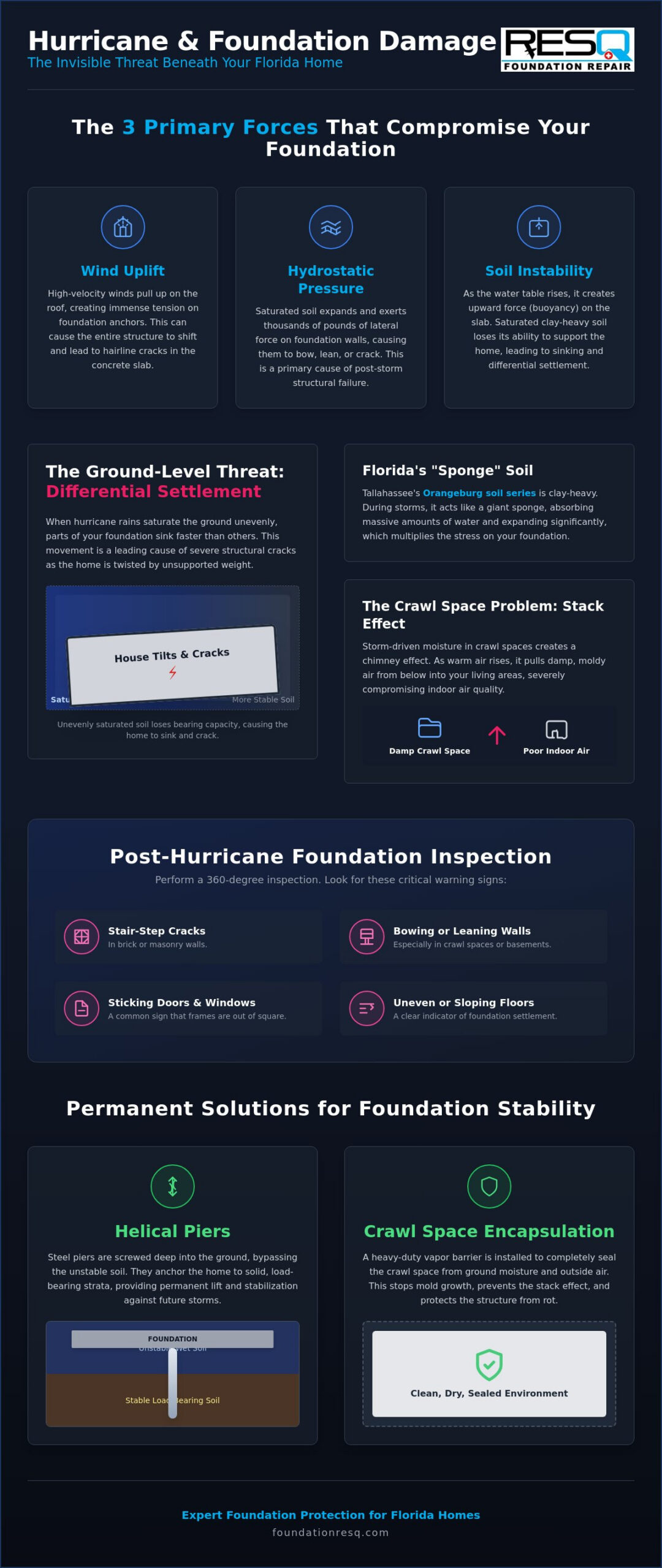
Florida’s intense weather patterns do more than just rattle your roof or scatter debris. To truly understand how hurricanes affect foundations in Florida, you have to look at the invisible pressure building up in the soil beneath your feet. While fast-moving wind-driven surges cause immediate and obvious erosion, slow-moving rain events often cause more insidious long-term structural harm. In Tallahassee, our unique soil composition, specifically the Orangeburg soil series, acts like a giant sponge. This clay-heavy soil absorbs massive amounts of water during a tropical storm, expanding significantly and putting immense stress on the concrete and masonry below your home.
Standard Hurricane-proof building methods often focus on anchoring the structure to the ground to resist wind, but even the best anchors can struggle when the ground itself becomes unstable. When the water table rises during a tropical system, it creates a powerful upward force against your home’s slab or crawl space floor. This buoyancy can cause the floor to heave or crack, especially in areas where the soil remains saturated for days after the storm has passed. The weight of the water in the ground is a constant, heavy force that doesn’t just disappear once the sun comes out.
Hydrostatic Pressure and Foundation Wall Stress
As the soil around your home becomes fully saturated, it expands and exerts thousands of pounds of lateral pressure against your foundation. This force pushes against the sides of your home with a weight that the structure wasn’t originally designed to handle. For homes with crawl spaces, this pressure can cause the walls to bow or lean inward as the weight of the wet earth becomes too much for the masonry to bear. Hydrostatic pressure is the primary cause of post-storm wall cracks and structural bowing in Florida homes. Over time, these cracks allow moisture and pests to enter, compromising the health of the entire building.
Soil Saturation and Differential Settlement
Not all soil saturates at the same rate across your property. If your gutters overflow or your yard has poor drainage, water concentrates in specific areas, such as the corners of the house. This leads to uneven saturation, where one side of your house may sink or shift faster than the other. This process is called differential settlement. While many people assume their home is just settling naturally after a heavy hurricane season, it’s often a sign of structural failure caused by the loss of soil bearing capacity. When the soil becomes a liquid-like slurry, it can no longer support the weight of the footings, leading to deep structural cracks that require professional stabilization.
Wind, Water, and Weight: The Three Pillars of Storm Damage
While the heavy saturation of Tallahassee’s clay soils creates pressure from below, the forces of wind and moving water attack your home’s stability from every other angle. Understanding how hurricanes affect foundations in Florida requires looking at the house as a complete system. In coastal areas, storm surge is the primary water threat. However, in inland cities like Tallahassee, we face a different challenge: ponding. When intense rainfall exceeds the ground’s ability to drain, water pools around the foundation for extended periods, turning the soil into a soft, unsupportive slurry. This standing water adds an immense downward load to your slab, often while hydrostatic pressure is simultaneously pushing upward from the rising water table.
High-velocity winds also play a surprising role in foundation health. When Category 3 or higher winds hit your home, they create significant uplift on the roof. This force acts like a giant hand trying to pull the house out of the ground. Because your home is built to transfer loads, this upward pull travels through the walls and puts extreme tension on the foundation anchors. If these anchors or the concrete they are set in are weakened, the entire structure can shift slightly. This shifting often results in hairline cracks across the concrete slab that may not be immediately visible after the storm.
Wind Uplift and Structural Shifting
The tug-of-war between your roof and your foundation is a critical aspect of storm resilience. Modern Florida Building Code foundation requirements mandate specific anchoring systems to resist these forces. Even with these standards, the repetitive stress of a long-duration storm can cause micro-movements. These shifts can crack the rigid concrete of your foundation, creating pathways for future water intrusion or pest infestations. If you notice new cracks in your flooring or interior drywall after a wind event, it’s a sign that the structural system was pushed to its limit.
Erosion and the Loss of Support
Moving floodwater and intense runoff are equally destructive. As water rushes across your property, it can cause “scouring,” where the soil is physically washed away from beneath the foundation footings. This leaves the heavy concrete suspended over air, which it is not designed to do. This same process often creates large voids under concrete driveways and walkways. If your home’s exterior paths have sunk or cracked following a storm, concrete leveling Tallahassee services using PolyRenewal can fill those voids and restore support before the damage spreads to the main structure.
Protecting your home means addressing these voids as soon as they appear. If you suspect your home has lost soil support or you’ve noticed sinking concrete, a professional evaluation from Foundation ResQ can help identify hidden gaps before they lead to a total structural failure.
Beyond the Cracks: Hurricane Impact on Crawl Spaces and Air Quality
While exterior cracks and soil shifts are visible signs of how hurricanes affect foundations in Florida, the damage often continues in the dark, damp environment of your crawl space. Hurricane-force rain doesn’t just fall; it’s driven sideways by intense wind, easily bypassing standard foundation vents. This creates a tropical microclimate under your home that persists long after the storm clouds have dispersed. When water enters this confined space, it saturates the soil and the wooden structural components that hold up your floors.
This trapped moisture doesn’t stay beneath your home. Because of a phenomenon called the “Stack Effect,” air naturally moves from the bottom of your house to the top. As warm air rises and escapes through your attic, it pulls replacement air upward from the crawl space. If that space is filled with stagnant water or high humidity, you are effectively breathing that air in your living room. This cycle can transport mold spores and musty odors directly into your home, compromising your indoor air quality and the health of your family.
The structural impact is equally concerning. Prolonged exposure to high humidity causes structural wood rot in floor joists and subflooring. Wood that remains damp for extended periods loses its load-bearing capacity, which can lead to sagging or “bouncy” floors. If left unaddressed, this moisture can turn a minor storm event into a major structural remediation project. Understanding how hurricanes affect foundations in Florida means looking past the concrete and checking the health of the wood and air beneath your feet.
Floodwater Incursion and Mold Growth
Mold growth is a race against time, often beginning within 48 hours of water exposure. Traditional foundation vents, while designed to provide airflow, frequently fail during Florida’s heavy tropical downpours by allowing wind-driven rain to flood the area. In the weeks following a hurricane, you should look for visible dark spotting on floor joists or a persistent earthy smell. If you discover growth, professional mold remediation Tallahassee FL services are necessary to safely remove the spores and prevent them from spreading through the Stack Effect.
The Necessity of Crawl Space Encapsulation
The most effective way to protect your home from storm-driven moisture is to create a permanent barrier between your structure and the elements. By opting for crawl space encapsulation Tallahassee, you seal off vents and line the space with a heavy-duty vapor barrier. This system works in tandem with sump pumps to remove any intruding water and industrial-grade dehumidifiers to maintain a consistent, dry environment. This remedy-based approach ensures that even when a hurricane hits, the air and wood beneath your home remain protected from the humidity and saturation that follow.
Post-Hurricane Inspection: Identifying Foundation Movement in Tallahassee
Once the storm clouds clear, it’s time to assess the structural health of your property. Understanding how hurricanes affect foundations in Florida is the first step toward recovery, but knowing what to look for requires a methodical approach. In Tallahassee, the Orangeburg soil series consists of a unique mix of red clay and sand. Unlike the limestone found in South Florida, this clay contracts and expands drastically. When a hurricane saturates this soil, it can swell; however, as it dries, it may shrink away from your foundation, leaving visible gaps that compromise stability.
You should begin your inspection with a 360-degree exterior walk-around. Pay close attention to the base of your home where the concrete meets the earth. If you notice new gaps in the soil or areas where the ground has visibly sunk, you’re likely looking at the results of erosion or scouring. Check the chimney as well. If you see a widening gap where the brick meets the siding, it’s a sign that the foundation is pulling away from the main structure.
Exterior Warning Signs: Cracks and Gaps
You must be able to distinguish between cosmetic shrinkage cracks and structural settlement cracks. Cosmetic cracks are usually thin and superficial, whereas structural cracks are often wider and follow a specific pattern. Look for “stair-step” cracks in your brickwork or siding. These are classic indicators that one section of your foundation is sinking faster than the rest. Measure the width of any new cracks with a ruler and record the date to track whether the movement is ongoing. You should also look for:
- Separation between the foundation and the soil.
- Cracks that wrap around the corners of the foundation.
- Visible tilting or leaning of exterior walls.
While identifying structural cracks is vital, homeowners should also assess the condition of their home’s protective shell. If your siding has been compromised, replacing it with moisture-resistant solutions from Paveezzi Composites can help prevent future water intrusion and rot.
Interior Indicators of Structural Stress
Inside the home, you might encounter “hurricane ghosts.” These are doors that suddenly stick or windows that won’t lock properly despite working perfectly before the storm. These issues occur because the frame has been pulled out of alignment by a shifting foundation. Pay close attention to cracks radiating from the corners of door and window frames, as these suggest the house is under significant structural stress. If your floors feel “bouncy” or uneven, it often indicates that the wood joists in your crawl space have been weakened by the intense moisture we discussed earlier.
You can use a simple level on your floors to check for post-storm shifting. If the bubble isn’t centered, your home may have experienced differential settlement. Because these issues can be subtle, a professional eye is often needed to catch damage before it becomes a collapse risk. If you’ve identified any of these warning signs, schedule a professional inspection with Foundation ResQ to secure your home’s future stability.
Protecting Your Home: Strategic Foundation Reinforcement and Recovery
Once you’ve identified the warning signs of storm damage, the focus must shift toward permanent stabilization. Many homeowners fall into the trap of “quick fixes,” such as DIY crack filling or cosmetic masonry repairs. These surface-level treatments are often dangerous because they hide the underlying structural issues while the house continues to shift. To truly address how hurricanes affect foundations in Florida, you must implement a remedy-based solution that accounts for Tallahassee’s saturated clay soils and intense hydrostatic pressure. Professional foundation repair Tallahassee ensures your home is reinforced before the next tropical system arrives.
Our goal is to create a protective barrier between your property and the elements. This involves moving beyond the unstable surface soil and anchoring the building to deeper, more reliable strata. By reinforcing the structure now, you avoid the slow-motion disaster of progressive settlement that often follows a major rain event. Whether your home sits on a slab or a crawl space, modern engineering provides non-invasive ways to restore integrity and provide long-term peace of mind.
Stabilization with Helical and Push Piers
Underpinning is the gold standard for homes experiencing settlement after a hurricane. In Tallahassee, the heavy clay near the surface becomes a slurry when saturated, losing its ability to support your home’s weight. Helical pier installation involves screwing steel shafts deep into the earth until they reach stable, load-bearing strata. These piers bypass the “sponge effect” of the upper soil layers entirely. Unlike cosmetic repairs, piering is a permanent solution that can often lift the foundation back to its original position, closing the “hurricane ghosts” and stair-step cracks we discussed earlier.
Carbon Fiber and Wall Stabilization
Hydrostatic pressure from rising water tables often leaves crawl space or basement walls bowing inward. If left unaddressed, these walls can eventually fail under the weight of the saturated earth. Carbon fiber straps offer a modern, high-strength solution for reinforcement. These straps are bonded directly to the interior of the foundation walls, providing immense tensile strength that prevents further movement. This is the preferred method for many Tallahassee homes because it is non-invasive and requires no excavation. For more details on the materials used, you can explore carbon fiber wall repair Tallahassee. By reinforcing these walls, you ensure your home remains a stable fortress against the lateral forces of future storms.
Securing Your Home Against Future Florida Storms
We have covered the complex forces that threaten your home’s stability, from the upward push of rising water tables to the lateral stress of saturated clay. Understanding how hurricanes affect foundations in Florida allows you to move from a state of uncertainty to one of informed action. By recognizing the early warning signs of settlement and the hidden dangers of crawl space moisture, you can address structural concerns before they compromise your home’s safety. Professional stabilization provides a permanent barrier between your home and the elements, ensuring that your foundation remains level even when the ground becomes saturated.
Foundation ResQ is a locally owned and operated team with national Groundworks backing, specializing in the specific geological challenges of Tallahassee. We provide free structural inspections for Tallahassee homeowners and offer transferable lifetime warranties on our pier systems. You don’t have to wait for the next storm to ensure your home is resilient. Taking these proactive steps ensures your home remains a stable haven for your family for years to come. We are here to help you build a more resilient future and protect the integrity of your investment.
Schedule your free post-storm foundation inspection with Foundation ResQ today
Frequently Asked Questions
Does Florida homeowners insurance cover foundation damage from a hurricane?
Standard Florida homeowners insurance policies typically don’t cover foundation damage caused by earth movement, even if that movement was triggered by a hurricane. While your policy might cover wind damage to your roof or siding, settlement and hydrostatic pressure are often categorized as excluded “earth movement” events. If you have separate flood insurance, it may cover certain types of structural damage caused directly by rising water, but it’s essential to review your specific policy with your agent to understand the distinction between flood damage and structural settlement.
How long after a hurricane should I wait to inspect my foundation?
You should perform an initial safety check as soon as it’s safe to go outside, but wait two to four weeks for a formal structural inspection. This delay allows the ground to dry and the soil to settle into its new position. Because of how hurricanes affect foundations in Florida, the most significant movement often occurs during the drying phase as Tallahassee’s clay soils shrink. Monitoring cracks over this period helps professionals determine if the movement is active or if the structure has stabilized.
Can heavy rain alone cause my foundation to sink without a named storm?
Heavy rainfall can cause foundation settlement and structural damage even without the presence of a named tropical system. In Tallahassee, intense summer downpours can saturate the Orangeburg soil series just as quickly as a hurricane, leading to high hydrostatic pressure and soil erosion. If your property has poor drainage or overflowing gutters, the concentrated water can create voids beneath your footings. This loss of support can cause your foundation to sink or shift regardless of wind speeds or storm classifications.
What is the difference between flood damage and foundation settlement?
Flood damage refers to the immediate impact of rising surface water on your home’s interior and exterior finishes, while foundation settlement is a structural failure caused by the soil’s inability to support the building’s weight. Flooding might ruin your drywall and flooring, but settlement involves the actual sinking or cracking of the concrete slab or footings. Settlement often occurs after the floodwaters recede and the saturated soil begins to shift or compress under the weight of the house.
Is it safe to live in a house with foundation cracks after a hurricane?
Whether it’s safe to remain in your home depends on the severity and location of the cracks. Small, hairline shrinkage cracks are often cosmetic, but wide “stair-step” cracks in masonry or cracks that allow you to see through the wall indicate a significant structural threat. If you notice doors that won’t close or a chimney that’s visibly leaning, the home’s integrity may be compromised. You should have a professional evaluate any new or expanding cracks to ensure the structure is safe for your family.
How much does it typically cost to stabilize a foundation in Florida?
The cost of foundation stabilization varies significantly based on the specific remedy required and the depth of the stable soil strata beneath your home. Factors such as the number of helical piers needed, the extent of wall reinforcement, and the accessibility of the work area all influence the final investment. Because every home in Tallahassee sits on a unique patch of soil, a professional inspection is required to provide an accurate estimate tailored to your home’s specific structural needs.
Can crawl space encapsulation prevent my home from flooding during a storm?
Crawl space encapsulation is designed to manage humidity and moisture, but it’s not a barrier against major storm surges or rising floodwaters. The primary goal of encapsulation is to prevent the “stack effect” and protect your floor joists from the high humidity that follows a Florida storm. While the heavy-duty vapor barrier and sump pump system can handle minor water intrusion and seepage, they aren’t intended to keep a crawl space dry if the entire property is submerged during a flood event.
What are helical piers and why are they used in Florida?
Helical piers are steel foundation pins that are screwed deep into the ground to reach stable, load-bearing soil layers. They’re a preferred solution in Florida because they bypass the unstable, saturated clay and sand near the surface that often fails during a hurricane. By anchoring your home to deeper strata, helical piers provide a permanent remedy for settlement. They’re especially effective for Tallahassee homes because they can be installed with minimal vibration, protecting the rest of the weakened structure during the repair process.