
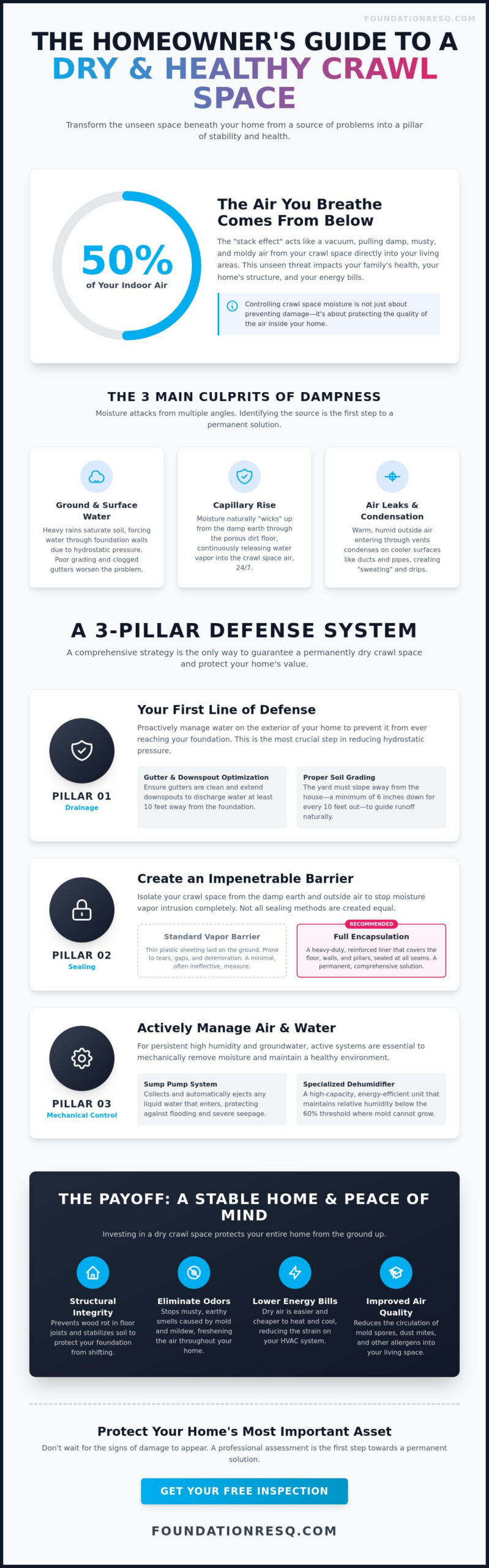
Did you know that nearly 50% of the air you breathe inside your home actually originates from your crawl space? Understanding how to keep crawl space dry is essential for any homeowner dealing with musty odors or rising energy bills that climb alongside the humidity. It’s a stressful situation to face, especially when you consider the risks of wood rot and structural instability. You deserve a home that feels stable and smells fresh, without the constant worry of what is happening beneath your floorboards.
This guide provides a professional roadmap to eliminate moisture and protect your home’s structural integrity from the ground up. We’ll show you how to transform a damp, neglected area into a controlled environment using a three pillar defense of drainage, sealing, and mechanical control. You’ll learn about the essential roles of crawl space encapsulation, sump pump systems, and specialized dehumidifiers. By following these steps, you can achieve a dry, odor free home and the peace of mind that comes with a truly stable foundation.
Key Takeaways
- Identify the specific sources of moisture, including liquid water intrusion and the wicking effect of capillary rise from the soil.
- Learn why high-capacity exterior drainage is the essential first line of defense against heavy seasonal rains and ground runoff.
- Discover the long-term benefits of crawl space encapsulation over standard vapor barriers for a permanent solution on how to keep crawl space dry.
- Understand the role of active mechanical systems, such as sump pumps and dehumidifiers, in managing high groundwater and persistent humidity.
- See how consistent moisture control preserves your home’s structural integrity by stabilizing the soil and protecting floor joists from rot.
Identifying the Source: Why is Your Crawl Space Wet?
Understanding moisture starts with recognizing that it exists in two distinct forms: liquid water and invisible water vapor. While a puddle on the floor is an obvious problem, high humidity is a silent threat that often goes unnoticed until damage occurs. To understand the basic structural purpose of this area, you can explore What is a Crawl Space? to see how these foundations are designed to interact with the earth. In the humid climate of Florida, moisture management is a constant battle against the elements.
One of the most common ways water enters is through a process called capillary rise. Even if the ground looks dry on the surface, moisture wicks upward through the dirt floor like water through a sponge. This movement is relentless and occurs 24 hours a day. Once that moisture enters the air, it doesn’t stay under your house. Because of the “stack effect,” warm air rising through your home creates a vacuum that pulls damp, low-quality air from the crawl space into your living areas. Nearly 50% of the air you breathe on the first floor originates from this sub-floor environment. Learning how to keep crawl space dry begins with a thorough inspection of these hidden moisture pathways.
The Three Main Culprits of Dampness
Groundwater seepage is a primary concern during the rainy season. When the soil becomes saturated, hydrostatic pressure forces water through porous foundation walls or the seams between the footings and the wall. Surface water intrusion is equally problematic. If your yard isn’t graded correctly or if your gutters are clogged, heavy rain pools against the foundation and finds its way inside. Finally, condensation occurs when warm, humid air enters through vents and hits cool surfaces like air conditioning ducts or copper pipes. This creates “sweating” that drips onto the wood structure below.
Signs of Trouble You Shouldn’t Ignore
You don’t always have to crawl under your home to know there’s a problem. Pay attention to these common warning signs:
- Musty Odors: A persistent “earthy” or damp smell in your closets or near baseboards usually indicates mold or mildew growth below.
- Visible Condensation: If you see water droplets on your AC vents or floor joists, the humidity levels are likely well above the safe threshold of 60%.
- Structural Changes: Bouncy, sagging, or uneven floors often mean that moisture has weakened the wood floor joists, compromising the stability of your home.
Identifying these sources is the first step toward a permanent remedy. Whether the issue is a plumbing leak or high ambient humidity, a professional assessment can help determine the exact combination of drainage and sealing required to protect your property’s integrity.
Exterior Defenses: Managing Drainage and Runoff
The exterior of your home acts as the first line of defense against structural decay. In North Florida, our seasonal rain patterns are intense and unforgiving. Tallahassee often experiences heavy downpours that can quickly overwhelm a poorly designed drainage system. When water saturates the soil directly against your foundation, hydrostatic pressure forces that liquid through porous masonry. This is why mastering how to keep crawl space dry begins long before you step foot under the house. By managing the path of rainwater, you significantly reduce the workload on your interior moisture management systems.
Science-based Moisture Control in Crawl Spaces confirms that keeping the ground around the foundation dry is the most reliable way to protect wood structures from rot. If the soil surrounding your home stays wet, the air underneath will stay humid. This persistent dampness eventually leads to mold growth and structural weakening. Professional drainage strategies focus on redirection, ensuring that gravity works in your favor rather than against your home’s stability.
Gutter and Downspout Optimization
Gutters are useless if they aren’t clear. During a typical Florida thunderstorm, look for overflow points that signal a blockage. Standard downspouts usually discharge water just a few feet from the wall, which is insufficient. We recommend installing underground downspout extensions to carry runoff at least 10 feet away. This ensures water is deposited where it can drain naturally without seeping back toward the foundation.
Proper Soil Grading and Landscaping
Your yard should work to move water away. A professional standard for grading is the “6 inches in 10 feet” rule, meaning the soil should slope downward at least six inches for every ten feet of distance from the house. Avoid “mulch dams” by piling bark too high against the foundation, as this traps moisture. Identifying “swales” or low spots in your yard is also vital for preventing persistent seepage.
If you notice water pooling near your home after a storm, it’s a sign that your exterior defenses need attention. Taking a proactive approach to foundation drainage management can save you from costly structural repairs later. By addressing these exterior issues now, you create a protective barrier that keeps your home’s foundation stable and secure through every season.
Sealing the Environment: Vapor Barriers vs. Encapsulation
Once you manage exterior drainage, the focus shifts to the internal environment of your home’s foundation. Many homeowners assume that laying down a thin sheet of plastic is enough to address moisture. However, there’s a significant difference between a basic vapor barrier and a professional encapsulation system. A simple vapor barrier only covers the dirt floor, leaving foundation walls and vents exposed to the elements. If you want to know how to keep crawl space dry permanently, you must treat the area as a sealed, conditioned space rather than an outdoor porch.
Durability is a major factor in choosing materials. Standard 6-mil plastic, often found in hardware stores, is prone to tearing. It’s easily damaged by technicians or homeowners crawling over it, and it lacks the longevity required for structural protection. Professional encapsulation utilizes a 20-mil, tear-resistant antimicrobial liner. This heavy-duty barrier is mechanically fastened and sealed to the foundation walls and piers, creating a continuous protective envelope. This process also involves sealing the sill plate and rim joists with spray foam to prevent outside air from leaking through the wooden frame of your home. Before committing to this investment, many Tallahassee homeowners research is crawl space encapsulation worth it to understand the real-world energy savings and long-term ROI for their specific climate and soil conditions.
The Problem with Traditional Vents
There’s a persistent myth that foundation vents help “dry out” a crawl space. In the humid Tallahassee climate, the opposite is true. When warm, moisture-laden air enters through vents, it hits the cooler surfaces of your subfloor and air conditioning ducts. This temperature difference causes the air to reach its dew point, resulting in heavy condensation. Closing and sealing these vents with permanent covers is a critical step in creating a controlled environment that rejects outdoor humidity.
The Professional Encapsulation Process
Encapsulation is a comprehensive remedy that goes beyond mere floor coverage. By sealing the liner to every vertical surface, we block moisture and soil gases from entering the home. This is vital for more than just structural health. According to the WHO guidelines on dampness and mould, preventing persistent indoor moisture is essential for maintaining a healthy living environment. A fully encapsulated space improves indoor air quality by ensuring that the air pulled into your home by the stack effect is clean and dry. This methodical approach transforms a damp, neglected area into a stable, bright, and protected part of your home’s thermal envelope.
Active Moisture Management: Sump Pumps and Dehumidifiers
While encapsulation creates a powerful barrier, it’s often just one part of a complete solution. In areas with high groundwater levels or heavy seasonal saturation, liquid water can still find its way beneath your home. Relying solely on a liner without a way to remove intruding water can lead to pooling and hidden damage. Learning how to keep crawl space dry under these conditions requires active mechanical intervention. These systems work automatically to detect and remove moisture before it can compromise your home’s structural integrity.
Professional mechanical systems provide a “set it and forget it” level of security. They’re designed to monitor conditions constantly and activate only when necessary, ensuring the environment remains stable regardless of the weather outside. This active approach is the final line of defense for your foundation, providing a remedy that addresses both liquid water and persistent humidity.
Installing a Sump Pump System
Liquid water needs a clear exit strategy. A professionally installed sump pump system collects water in a specialized basin and pumps it safely away from the foundation. Selecting the right pump capacity is essential for Florida’s unique soil conditions, where saturation happens quickly during summer storms. Because Tallahassee is prone to frequent power outages during these weather events, battery backup systems are a non-negotiable component. A backup ensures the pump continues to operate even when the grid fails. For homeowners in our area, expert Sump Pump Installation in Tallahassee provides the reliability needed for long term protection.
Maintaining Ideal Humidity Levels
Even without standing water, high humidity remains a threat. The target relative humidity for a healthy crawl space is strictly between 45% and 55%. If levels exceed 60%, the environment becomes a breeding ground for dust mites and fungi. It’s vital to use a specialized, high-capacity crawl space dehumidifier rather than a standard unit from a “big box” store. Commercial grade units are designed to operate in cooler, tighter spaces and can move significantly more moisture per day. For Tallahassee homeowners dealing with the Florida Panhandle’s relentless humidity, understanding the specifics of crawl space dehumidifier installation Tallahassee professionals recommend is essential for selecting the right capacity equipment and ensuring long-term performance. This active control effectively prevents mold growth in crawl space and stops wood rot from taking hold in your floor joists.
Active moisture management transforms your crawl space into a controlled part of your home’s infrastructure. If you’re concerned about rising humidity or pooling water, exploring professional Crawl Space Dehumidifiers is a decisive step toward a healthier home.
Protecting Your Tallahassee Home’s Structural Integrity
Maintaining a dry foundation environment is a form of structural insurance. When you invest in learning how to keep crawl space dry, you’re performing essential preventative maintenance for your entire property. Excess water in the soil causes it to expand or erode, which eventually undermines the footings of your home. Consistent moisture levels keep the ground stable. This ensures your house doesn’t shift or settle unevenly as the seasons change.
If moisture issues are left unaddressed, they often escalate into significant structural failures. There’s a direct correlation between chronic dampness and the need for foundation repair Tallahassee homeowners frequently encounter. When wood rot from high humidity meets soil instability from groundwater, the safety of the building is compromised. It’s much more cost-effective to manage water today than to lift a sinking foundation tomorrow.
Why Local Expertise Matters
Tallahassee presents unique geological challenges. Our region features a mix of heavy clay and sandy soils that react dramatically to North Florida’s intense rainfall. Foundation ResQ uses a remedy-based framework to provide permanent fixes rather than temporary patches. We understand how local weather patterns affect your home’s stability. Seeking a professional inspection before small issues grow is the best way to protect your investment.
The Long-Term Value of a Dry Crawl Space
A dry crawl space provides benefits that extend far beyond the foundation walls. It significantly increases home resale value because documented encapsulation proves the home has been well-maintained. You’ll also see a difference in your utility bills. Research shows that homes with a sealed crawl space can use an average of 20% less energy for heating and cooling. This happens because your HVAC system no longer has to work overtime to remove moisture from the air.
To help you monitor your home’s health, use this simple checklist:
- Check for standing water after heavy summer storms.
- Monitor for new cracks in interior drywall or sticking doors.
- Ensure downspout extensions remain connected and clear of debris.
- Verify that your dehumidifier is maintaining a humidity level below 55%.
Protecting your home starts with a thorough understanding of what’s happening beneath your feet. For a comprehensive evaluation of your foundation’s health, Contact Foundation ResQ for a professional crawl space inspection and take the first step toward a more stable, efficient home.
Take Control of Your Home’s Foundation Health
Achieving a permanent solution for a damp foundation requires more than a quick fix. It demands a comprehensive strategy that addresses the root causes of moisture. You’ve learned that effective moisture management involves a combination of robust exterior drainage, professional grade encapsulation, and active mechanical systems. Mastering how to keep crawl space dry is the most effective way to preserve your home’s structural integrity and improve your indoor air quality for years to come.
Foundation ResQ brings specialized North Florida soil expertise and a commitment to industry-leading solutions to every project. We utilize durable, antimicrobial moisture barriers designed to provide a permanent line of defense against the elements. Our team focuses on long term outcomes that stabilize your foundation and protect your building’s health. Don’t wait for small moisture issues to become costly structural repairs. Take the first step toward a drier, healthier home today.
Schedule Your Free Crawl Space Inspection with Foundation ResQ and gain the peace of mind that comes with a professionally protected foundation.
Frequently Asked Questions
Is it normal to have a little water in my crawl space after a heavy rain?
No, standing water is never considered normal for a healthy foundation. Even a small amount of water suggests that your exterior drainage is insufficient or that groundwater is seeping through the walls. If left unaddressed, this moisture creates a breeding ground for wood rot and mold. Professional intervention is required to identify the entry point and implement a permanent remedy that keeps the area dry.
How much does it cost to encapsulate a crawl space in Florida?
The total investment for encapsulation depends on several variables including the square footage of the space, the height of the foundation walls, and the current state of the structure. Factors such as the need for mold remediation or the installation of a sump pump also influence the final cost. Because every home is unique, we recommend a professional assessment to determine the specific requirements for your property.
Can I use a regular fan to dry out my crawl space?
A regular fan is not an effective solution for moisture control. While it might move air around, it doesn’t actually remove water vapor from the environment. In fact, using a fan in a vented crawl space often pulls in more humid outdoor air, which can make the problem worse. A specialized dehumidifier is the only way to actively lower the relative humidity to safe levels.
What is the ideal humidity level for a crawl space?
You should aim to maintain a relative humidity level between 45% and 55%. According to the EPA, humidity levels that exceed 60% create the perfect conditions for mold growth and dust mites. Keeping these levels consistent is a key part of understanding how to keep crawl space dry and protecting the air quality inside your home’s living areas.
Does a vapor barrier alone stop mold growth?
A vapor barrier alone is often insufficient to stop mold. While a liner blocks moisture from the soil, it doesn’t address humidity entering through vents or water seeping through foundation walls. To truly prevent mold, you need a comprehensive encapsulation system that seals the entire environment. This often includes active moisture removal through a professional dehumidifier or a sump pump system.
How long does a crawl space dehumidifier last?
A high quality, commercial grade dehumidifier typically lasts between five and ten years. This lifespan depends heavily on regular maintenance and the severity of the moisture issues it must manage. Unlike retail units, professional models are built with durable components that can withstand the harsh, damp conditions found under a home. Periodic filter changes and inspections help ensure the unit operates at peak efficiency.
Will keeping my crawl space dry lower my energy bills?
Yes, maintaining a dry crawl space is a proven way to lower your monthly utility costs. When the air under your home is dry, your HVAC system doesn’t have to work as hard to remove humidity from the living space. Research indicates that homeowners with sealed and conditioned crawl spaces can save an average of 20% on their heating and cooling energy usage.
Should I close my crawl space vents in the summer?
You should keep your vents closed if you are pursuing a modern moisture management strategy. In the humid Florida summer, open vents allow heavy, damp air to enter the crawl space where it condenses on cool surfaces. Closing these vents is a critical step in learning how to keep crawl space dry because it allows you to control the internal climate and stop the cycle of condensation.