
Did you know that the massive oak in your front yard isn’t actually “punching” through your concrete foundation? Most Tallahassee homeowners assume tree roots act like battering rams, but the real threat is much quieter and more complex. In our local “Red Hills” region, the expansive smectite clay soil reacts heavily to moisture levels. When a thirsty tree drinks up all the subsurface water during a dry Florida summer, the soil shrinks and contracts. This creates a void that causes your home to settle unevenly. Understanding this process is the first step in preventing foundation damage from trees Tallahassee homeowners often fear.
We understand the anxiety of choosing between a historic canopy tree and a stable home. It’s a difficult position to be in, especially with local tree removal permits costing $273 and strict ordinances protecting our beautiful landscape. You don’t want to lose your shade, but you can’t ignore those growing cracks in the brickwork. This guide provides a clear, professional plan to help you preserve your trees while ensuring your home remains on solid ground. We will explain how to distinguish between soil-related settlement and root intrusion, when to consult a certified arborist, and which stabilization methods offer the most durable protection for your property’s long-term health.
Key Takeaways
- Understand how root-driven soil desiccation causes differential settlement in Tallahassee’s expansive clay soils.
- Discover effective methods for preventing foundation damage from trees Tallahassee, including the use of HDPE root barriers and strategic planting distances.
- Learn to recognize the specific visual cues, such as stair-step exterior cracks, that indicate tree roots are affecting your home’s stability.
- Explore why professional stabilization with helical piers is often a more effective long-term solution than simply removing a mature tree.
The Relationship Between Tallahassee Trees and Home Foundations
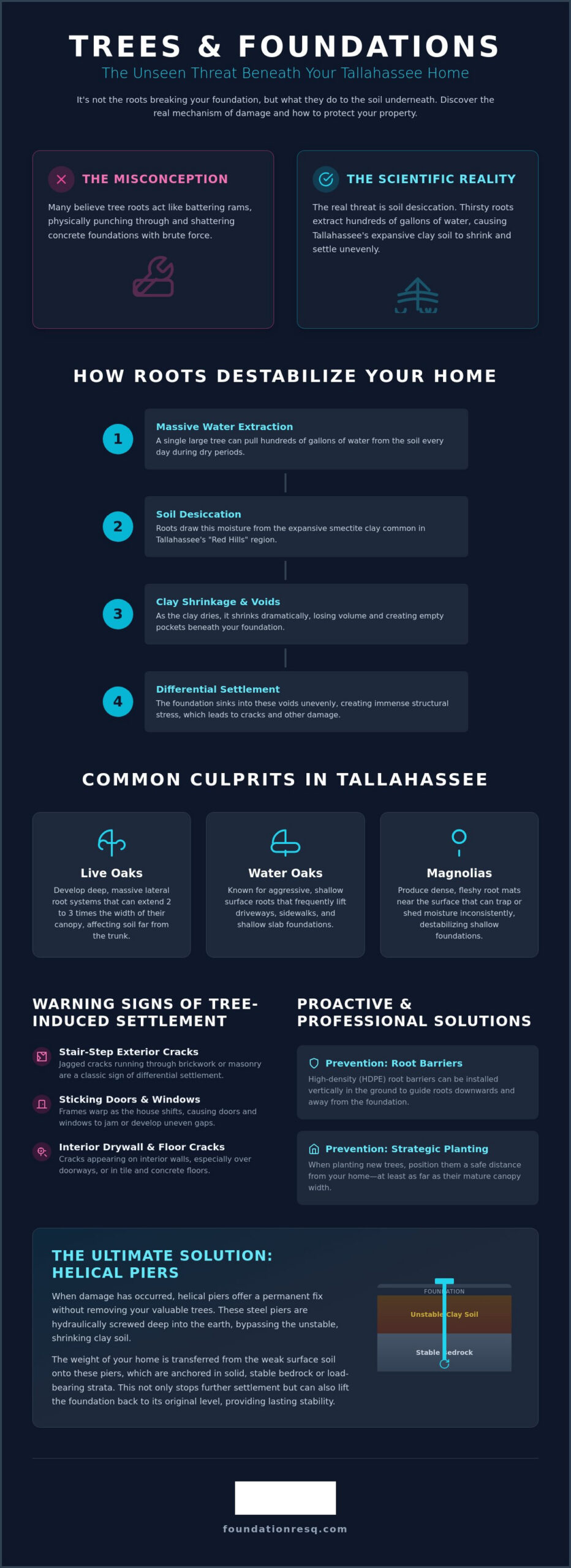
Tallahassee is defined by its lush, shaded streets and iconic canopy roads. While these majestic trees provide character and cooling shade, they also present hidden structural risks to the homes they surround. Most homeowners assume that roots act like biological drills, physically puncturing concrete slabs. In reality, the interaction is much more subtle. When we discuss preventing foundation damage from trees Tallahassee residents must look beneath the surface at how roots alter the soil’s environment. While direct root pressure can occasionally lift a driveway or sidewalk, the primary threat to your home’s integrity is the way roots manage moisture.
North Florida homes face unique vulnerabilities compared to those in South Florida. In the southern part of the state, sandy soils allow water to move freely and don’t change volume significantly when dry. However, our region sits on heavy, expansive clay. Roots act as powerful hydraulic pumps, extracting hundreds of gallons of water from the earth every day. During our intense dry spells, this moisture extraction causes the clay to shrink. As the soil loses volume, it can no longer support the weight of your foundation, leading to uneven settlement. Understanding these dynamics is the first step toward Proactive Strategies for Preventing Root-Related Damage before it requires major intervention.
Common Tallahassee Tree Species and Their Root Habits
Different trees interact with your foundation in specific ways based on their biological needs. It’s helpful to recognize the habits of our most common local species:
- Live Oaks: These long-lived giants develop deep systems but have a massive lateral spread. Their roots often extend two to three times the width of the canopy, meaning a tree across the yard could still be affecting the soil under your crawl space.
- Water Oaks: Known for a shorter lifespan, these trees have aggressive surface roots. They’re frequently responsible for the visible lifting of shallow slab foundations and exterior hardscaping.
- Magnolias: These trees produce dense, fleshy root mats. These mats can impact shallow foundations by creating a thick layer of organic material that holds or sheds moisture inconsistently.
Tallahassee’s Red Hills: How Local Soil Reacts to Roots
The “Red Hills” region is famous for its Orangeburg fine sandy loam, which contains high concentrations of smectite clay. This specific clay type has a high shrink-swell capacity. When a tree’s root system draws moisture from this clay, the soil particles pull closer together, causing the ground to physically drop. This often creates a “cup effect” around a home. The soil under the center of the house stays relatively moist and stable, while the soil around the perimeter is dried out by nearby trees. This uneven support is what leads to the structural cracks and sticking doors many Tallahassee homeowners experience.
The Mechanism of Damage: How Roots Destabilize Your Home
Many homeowners imagine tree roots as biological battering rams that physically punch through solid concrete. This is a common misconception. In reality, roots are opportunistic. They follow the path of least resistance, seeking out pockets of moisture and air. While they rarely “pierce” a sound foundation, they’re experts at finding microscopic fissures or existing plumbing gaps. Once inside, they expand, widening those cracks and compromising the structural seal. However, the most significant threat to your home’s stability isn’t the root itself, but what the root does to the ground beneath your feet. Understanding this invisible process is essential for preventing foundation damage from trees Tallahassee residents deal with every summer.
The primary culprit in North Florida is a phenomenon known as differential settlement. When a large tree is positioned near one corner of a house, it doesn’t draw moisture evenly from under the entire floor plan. Instead, it creates a localized dry zone. This leads to a situation where one side of your home rests on firm, moist soil, while the other side sits on shrinking, desiccated clay. This imbalance creates immense structural stress, leading to the cracks and shifting floors that signal a failing foundation.
Soil Desiccation and Settlement
Soil desiccation occurs when a tree’s thirst exceeds the available rainfall, forcing the root system to pull water from deep within the clay layers supporting your home’s footers. In our clay-heavy Red Hills environment, this moisture loss causes the soil to physically lose volume. As the clay pulls inward and downward, it leaves a void between the bottom of your foundation and the ground. Because the weight of a house is constant, the foundation inevitably drops into these voids. Soil desiccation is the primary cause of settlement in clay-rich Tallahassee, often manifesting as cracks that grow wider during the hot, dry months of July and August.
Pressure and Intrusion
While moisture extraction is the lead cause of settlement, physical pressure still plays a role. As roots grow in diameter, they can exert significant force against foundation walls or perimeter drainage systems. This pressure can interfere with how water moves away from your home, potentially increasing hydrostatic pressure against your basement or crawl space walls during heavy storms. If roots manage to breach a crawl space, they can trap moisture against wooden joists or even compromise crawl space encapsulation systems by puncturing vapor barriers. If you suspect your landscape is winning the battle against your home’s structure, a professional foundation evaluation can help identify the specific mechanism of damage before it requires more invasive repairs.
Proactive Strategies for Preventing Root-Related Damage
Protecting your home doesn’t always mean reaching for a chainsaw. Many homeowners find themselves caught between the desire for a lush canopy and the need for structural stability. By implementing specific landscape management techniques, you can enjoy the benefits of mature trees while effectively preventing foundation damage from trees Tallahassee’s climate makes so common. The goal is to create a sustainable distance and a protective barrier between aggressive root systems and your home’s footer.
For new plantings, distance is your best defense. Large hardwoods like Live Oaks should ideally be placed at least 30 to 50 feet from the foundation. Smaller ornamental trees can be closer, but a 15-foot minimum is a safe baseline for most species. If you’re managing an existing landscape where trees are already established, you’ll need to focus on physical redirection and moisture control.
Installing Root Barriers Correctly
Physical barriers are one of the most reliable methods for underground root deflection. High-Density Polyethylene (HDPE) sheets are the industry standard for this task. These sheets are buried vertically between the tree and the foundation to redirect root growth downward or away from the structure. In Tallahassee’s clay soil, these barriers should typically reach a depth of 24 to 36 inches. This depth accounts for the shallow nature of most aggressive lateral roots in our region. While chemical barriers exist, they rely on herbicides that may lose effectiveness over time. It’s vital to install these barriers outside the tree’s drip line to avoid causing significant stress or instability to the tree itself.
Landscaping for Foundation Health
Selecting the right species is just as important as where you plant them. Opt for foundation-friendly shrubs like dwarf azaleas or boxwoods that have non-invasive root systems. Proper water management is also key. Smart irrigation involves watering the tree’s root zone deeply but infrequently, and always away from the home’s footer. This encourages roots to grow outward toward the water source rather than inward toward the moisture trapped under your slab. Using a layer of organic mulch around the base of the foundation also helps. Mulch regulates soil temperature and moisture levels, preventing the clay from drying out too quickly during a drought.
If you suspect roots are already too close, you might consider root pruning. This process requires a delicate balance. Cutting a major structural root can kill the tree or make it a fall hazard during a storm. Always hire an ISA Certified Arborist to perform this work. They understand how to maintain the tree’s health while protecting your home’s perimeter. Taking these steps now can save you from the high costs of structural remediation later.
Identifying the Warning Signs of Tree-Induced Foundation Failure
Early detection is the most effective way to limit repair costs and preserve your home’s structural integrity. While some settling is natural for North Florida homes, tree-induced damage follows specific patterns that distinguish it from standard seasonal shifts. When you’re focused on preventing foundation damage from trees Tallahassee climate conditions make worse, you must look for visual cues that indicate the soil is no longer providing uniform support. Settlement caused by thirsty roots often manifests in a predictable sequence across your property.
- Step 1: Exterior Brickwork. Inspect your home’s facade for stair-step cracks. These diagonal fissures follow the mortar lines between bricks and usually indicate that one section of the footer is dropping faster than the rest.
- Step 2: Interior Openings. Monitor the drywall around windows and doors. If you notice cracks extending from the corners or if doors suddenly begin sticking in their frames, it’s a sign the frame is no longer square due to foundation movement.
- Step 3: Floor Stability. In homes with crawl spaces, pay attention to “bouncy” or sloping floors. This often happens when the perimeter footers settle while the interior piers remain stable.
- Step 4: Tree Proximity. Observe the health of trees within 20 feet of your home. A tree that appears stressed during a dry spell may be aggressively seeking moisture from beneath your slab, exacerbating soil shrinkage.
Exterior vs. Interior Indicators
It’s vital to distinguish between minor cosmetic issues and structural threats. While vertical cracks are often caused by minor shrinkage, horizontal cracks in a foundation wall are a major red flag indicating significant lateral pressure or severe settlement. You should also look for a visible gap between your chimney and the main structure of the house. This separation is a classic indicator that the heavy masonry of the chimney is pulling away as the underlying soil fails. For a comprehensive checklist of symptoms, you can review our guide to foundation repair Tallahassee homeowners can use to evaluate their property’s health.
Crawl Space Red Flags
If your home sits on a raised foundation, the crawl space offers a direct window into your home’s structural health. Roots can sometimes breach crawl space vents or grow directly under the footers of support piers. These roots don’t just displace soil; they also trap moisture against the wooden subfloor and joists. This creates an environment ripe for wood rot and fungal growth. The connection between aggressive roots, trapped moisture, and structural decay often leads to a secondary need for mold remediation Tallahassee FL residents frequently encounter in older neighborhoods. If you identify these warning signs early, a professional structural inspection can help you determine the best path forward before the damage spreads.
Professional Stabilization Solutions for Tallahassee Homes
When homeowners discover structural issues, their first instinct is often to remove the offending tree immediately. However, simply cutting down a mature tree can sometimes make foundation damage worse. This is known as the “rebound effect.” For years, the tree has kept the soil beneath your home relatively dry. Once removed, that clay soil suddenly absorbs a massive amount of moisture it hasn’t seen in decades, causing it to swell and heave. This upward pressure can crack a foundation just as easily as the initial settlement. A strategic approach to preventing foundation damage from trees Tallahassee residents can rely on involves stabilizing the home first, ensuring it remains secure regardless of whether the tree stays or goes.
Underpinning with Helical and Push Piers
The most reliable way to secure a home in North Florida’s shifting clay is through professional underpinning. A helical pier installation involves driving steel shafts deep into the earth, far below the root-affected zones and the unstable “active” soil layers. These piers transfer the weight of your home to stable, load-bearing strata or bedrock. This method provides a permanent fix because the foundation is no longer dependent on the surface soil moisture levels that trees manipulate.
Whether we use helical piers or push piers, the result is a stabilized structure that resists future settlement. By bypassing the problematic Red Hills clay altogether, we create a lasting remedy that protects your investment for decades. This allows you to keep your historic oaks without fearing for your home’s structural integrity. It’s a proactive way of preventing foundation damage from trees Tallahassee homeowners often find is the most cost-effective long-term choice.
Reinforcing Walls with Carbon Fiber
If root growth or soil expansion has caused your foundation walls to bow inward, stabilization requires more than just piering. We use carbon fiber wall repair Tallahassee homeowners trust for its high-strength, low-profile results. These straps are bonded directly to the interior masonry, providing a tension-based reinforcement that is significantly stronger than steel. It’s the preferred choice for North Florida homes because it stops inward movement without requiring invasive excavation or interior remodeling.
For secondary structures like sunken walkways or porch slabs affected by root intrusion, we utilize PolyRenewal concrete lifting. This high-density polyurethane foam is injected beneath the slab, expanding to fill voids and gently lifting the concrete back to its original position. This combination of deep stabilization and surface restoration ensures your entire property is protected. While the Tallahassee canopy is a point of pride, your home’s safety is our priority. Professional intervention ensures both can coexist safely.
Securing Your Home’s Future in the City of Oaks
Balancing a beautiful landscape with a stable home requires a clear understanding of how our local Red Hills clay interacts with thirsty root systems. The primary threat to your structure is rarely the roots themselves but the uneven soil shrinkage they cause during dry spells. By focusing on deep-tier stabilization and the early detection of warning signs like stair-step cracks, you can protect your investment without sacrificing the mature trees that define your property. Taking a proactive stance is the most effective method for preventing foundation damage from trees Tallahassee homeowners face during our intense Florida summers.
Foundation ResQ has provided localized structural expertise across North Florida and South Georgia since 2013. Our Groundworks-backed permanent solutions are specifically designed to withstand the unique geological challenges of our region, offering you lasting durability and peace of mind. You don’t have to choose between your home’s integrity and your favorite oak tree when you have a professional plan in place.
Don’t wait for minor seasonal shifts to become major structural failures. Schedule Your Free Foundation Inspection with Foundation ResQ Today to ensure your home remains on solid ground. We’re here to help you protect your home with dependable, expert guidance.
Frequently Asked Questions
Can I just cut the tree roots that are near my foundation?
Cutting major structural roots without professional guidance is dangerous and can lead to the tree becoming unstable or dying. In Tallahassee, where lightning strikes and storms are frequent, a compromised tree is a significant hazard to your home. Always consult a certified arborist to perform root pruning, as they can balance the tree’s health with the goal of preventing foundation damage from trees Tallahassee homeowners often worry about.
How far should an oak tree be from a house in Florida?
Large hardwood species like Live Oaks should ideally be planted at least 30 to 50 feet away from any permanent structure. Their lateral root systems are extensive and can spread far beyond the visible canopy. Maintaining this distance ensures that the tree’s moisture extraction doesn’t lead to soil desiccation and subsequent foundation settlement under your home’s footer.
Will removing a tree fix my foundation problems?
Removing a tree rarely fixes existing structural damage and can actually cause a rebound effect where the soil swells as it rehydrates. This upward pressure can lead to new cracks or worsen current ones as the clay expands. It’s usually necessary to stabilize the foundation with professional underpinning before or during the tree removal process to ensure the home remains secure during soil shifts.
Does homeowners insurance cover foundation damage from tree roots?
Standard Florida homeowners insurance policies typically don’t cover foundation repair caused by tree roots or soil movement. While state law requires coverage for catastrophic ground cover collapse, damage from gradual root-induced settlement is generally considered a maintenance issue. You should check your specific policy for sinkhole add-ons or structural endorsements that might offer localized protection.
What is the best type of tree to plant near a house in Tallahassee?
Small ornamental trees with non-aggressive root systems, such as Dogwoods or Eastern Redbuds, are better choices for areas near a foundation. These species have smaller footprints and lower water demands than large oaks or magnolias. For the best results, stick to native Florida shrubs that can be easily managed and won’t compromise the stability of your home’s perimeter soil.
How do I know if a crack is caused by a tree or just normal settling?
Tree-related cracks often appear or widen during the hot, dry months when roots are most active in seeking water from the clay. These fissures are frequently stair-stepped in exterior brickwork and located on the side of the house closest to the tree. Normal settling is usually more uniform across the structure, whereas root-induced damage is localized to where the soil is shrinking.
Can root barriers be installed for already mature trees?
Yes, root barriers can be installed for mature trees, provided they’re placed carefully to avoid damaging the tree’s structural stability. The barrier should be installed outside the tree’s drip line to allow the main root mass to remain healthy while redirecting lateral growth. This is a common proactive strategy for preventing foundation damage from trees Tallahassee residents use to save their historic canopy.
How much does it cost to fix foundation damage from trees in Tallahassee?
The cost of structural remediation varies based on the severity of the settlement and the number of piers required for permanent stabilization. Minor repairs for small fissures are less intensive, while major structural work involving helical piers or wall reinforcement represents a larger investment in your home’s longevity. A professional inspection is the only way to get an accurate assessment of the necessary remedy for your property.