
Your Tallahassee home is only as strong as the soil beneath it, and in Leon County, that soil is often working against you. With an average of 59 inches of annual rainfall saturating our local clay-rich ground, it is common for foundations to shift, sink, or settle unevenly over time.
It’s deeply unsettling to notice new cracks in your drywall or a door that suddenly sticks, especially when you start worrying about the long-term safety of your family. You need a solution that actually fixes the root cause rather than just masking the symptoms, yet the fear of a destroyed yard often keeps homeowners from seeking help. We understand that you want professional validation and a permanent fix that doesn’t involve turning your property into a major construction zone.
In this guide, you’ll discover why the push pier foundation repair system is the most reliable, minimally invasive remedy for stabilizing a sinking house in Florida’s unique environment. We will explain how high-strength steel piers bypass unstable surface soil to reach deep, competent strata, providing your home with a level foundation and the protection of long-term warranty coverage.
Key Takeaways
- Learn how the push pier foundation repair system utilizes high-strength steel to bypass unstable surface soils and reach competent load-bearing strata deep underground.
- Understand the engineering behind load transfer and why galvanized steel is the superior choice for resisting corrosion in Tallahassee’s damp, clay-rich environment.
- Discover the critical differences between push and helical piers to determine which underpinning method is most effective for your specific home structure.
- Follow the professional installation process from the initial structural inspection through to site restoration and rigorous load testing.
- Find out why partnering with a local expert who understands Leon County’s unique geological zones is essential for securing long-term structural stability.
Understanding the Push Pier Foundation Repair System
A push pier foundation repair system is a sophisticated underpinning solution designed to stabilize a home that has begun to sink or settle. In the industry, professionals often refer to these as resistance piers because they rely on the existing weight of your house to drive the steel sections into the earth. By utilizing the home’s own mass, the system pushes through unstable soil until it reaches a solid, load-bearing layer. This process is a specialized form of Understanding Underpinning, which involves strengthening the foundation of an existing building to ensure its long-term structural health.
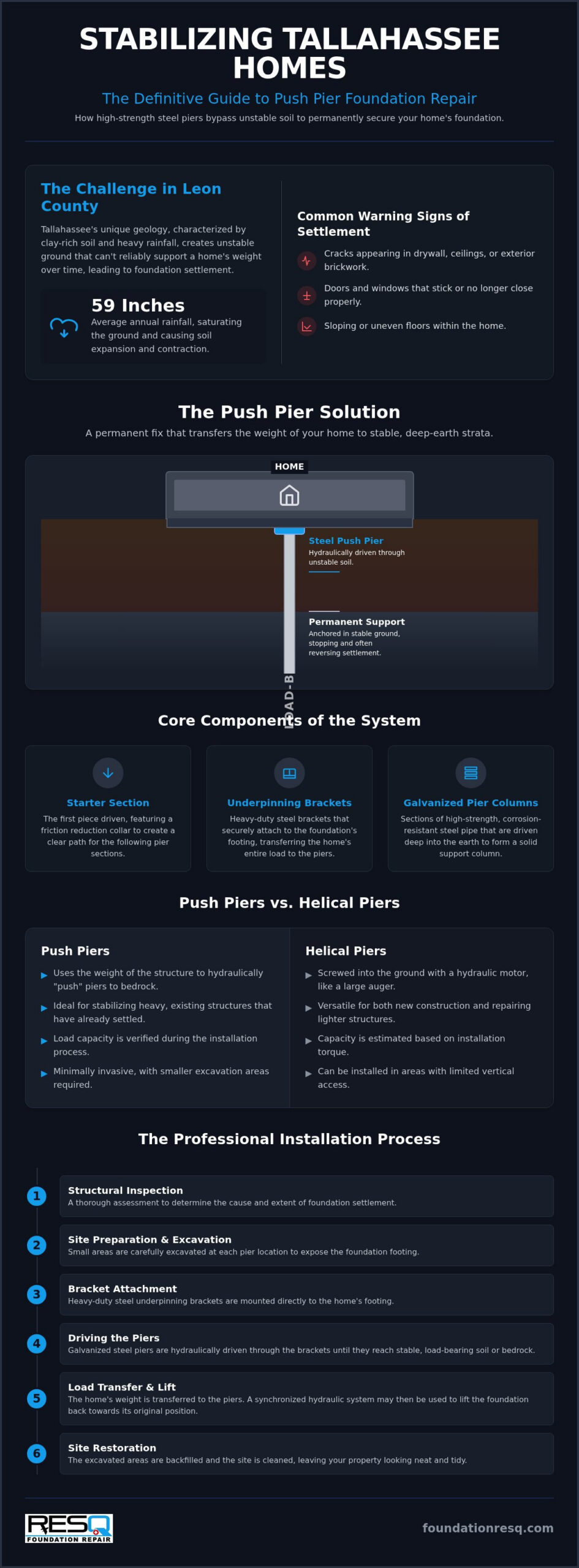
The system works by attaching heavy-duty steel brackets directly to your home’s concrete footings. Once these brackets are secure, a hydraulic ram is used to drive high-strength steel pier sections deep into the ground. Unlike cosmetic fixes that only hide cracks, this method addresses the structural failure at its source. It provides a stable, permanent platform that can often be used to lift the home back toward its original, level position.
Why Tallahassee Soil Demands Steel Piering
Tallahassee presents a unique challenge for homeowners. We deal with an average of 59 inches of annual rainfall, which creates a constant cycle of saturation and drying in our local clay-rich soils. This moisture causes the earth to expand and contract, eventually losing its ability to support the weight of a heavy structure. When the ground becomes too soft or shifts during a dry spell, the foundation begins to settle.
The local geology is often a mix of limestone and unpredictable clay layers. Surface soil, which we sometimes call “junk soil,” isn’t strong enough to hold a building steady. The push pier foundation repair system is effective here because it doesn’t rely on that unstable surface soil. Instead, it bypasses those weak layers entirely, reaching down into competent, deep-earth strata that aren’t affected by seasonal weather changes or surface water runoff.
Core Components of a Push Pier System
The durability of this remedy depends on the quality of its parts. Because Florida’s ground is often damp, we use galvanized steel pier sections. This coating provides essential corrosion resistance, ensuring the piers don’t weaken over decades of service in the earth. The system is built to last as long as the home itself.
- Starter Section: This is the first piece driven into the ground. It features a friction reduction collar that creates a slightly larger hole than the pier itself, reducing the force needed to reach deep soil.
- Underpinning Brackets: These custom-engineered brackets are the connection point between your home and the piers. They are designed to transfer the massive weight of the structure safely onto the steel supports.
- Pier Columns: Multiple sections of high-strength steel are connected and driven until the system hits the necessary resistance to support the house.
Engineering Stability: How Steel Push Piers Restore Your Home
The push pier foundation repair system works by redirecting the immense weight of your home away from failing surface soils. Instead of the footing resting on unstable clay, the load is transferred through high-strength steel columns to deeper, more competent earth. This mechanical shift is achieved using hydraulic rams that provide a steady, controlled force. Because the process is gradual and monitored, it minimizes the risk of sudden movements that could cause secondary damage to your masonry or interior finishes.
Galvanized steel is the standard for these installations in Tallahassee. Our local soil is frequently saturated due to heavy seasonal rains, which can accelerate the oxidation of untreated metals. By using galvanized coatings, we provide a protective barrier that prevents rust and ensures the structural remedy remains a permanent part of your home’s defense system. This durability is essential in Florida, where high water tables and high humidity are constant factors.
Concentric vs. Eccentric Pier Designs
Choosing the right hardware depends on your home’s specific footprint and the condition of your footings. Concentric piers are installed directly beneath the center of the foundation wall. This alignment allows for the most efficient transfer of weight, as the load travels in a straight line down the pier. It is often the preferred choice for heavy masonry structures where maximum support is required.
Eccentric piers use brackets that attach to the side of the footing. These are invaluable when access is restricted or when the footing’s shape prevents a direct under-wall installation. A steadfast local expert will evaluate your property to determine which bracket style provides the most secure fit for your stabilization project. If you’re seeing signs of settlement, you can request a professional inspection to identify the best engineering approach for your home.
The Importance of Load Testing
We don’t guess when it comes to your home’s safety. Every pier in a push pier foundation repair system is individually load-tested during the actual driving process. We use the weight of the structure itself as the reaction force, ensuring that each pier can support more than its required portion of the home’s weight before the installation is complete. This verification confirms that the pier has reached a point of refusal in the deep soil strata. Load testing is the critical safety check that guarantees structural success by providing measurable proof of stability for every support point.
Push Piers vs. Helical Piers: Selecting the Right Support
Deciding between different piering types is a technical choice that depends on the specific physics of your home. A push pier foundation repair system relies on the weight of the building to drive steel sections deep into the ground. In contrast, helical piers are screwed into the earth using hydraulic torque. While both methods provide a permanent remedy for settlement, the specific load requirements of your house will dictate which system is most appropriate for long-term stability.
Soil density and depth play a major role in this engineering decision. In Tallahassee, where we often find layers of expansive clay over deeper limestone, the ability to reach stable ground is paramount. Push piers are driven until they hit a point of refusal, meaning the soil can no longer be penetrated by the force of the home’s weight. Helical piers are installed based on torque measurements, making them a versatile choice when the building itself isn’t heavy enough to act as a counter-weight during the installation process.
When to Choose Push Piers
Push piers are the superior choice for heavy, multi-story masonry homes or commercial properties. Because these structures have significant mass, they provide the necessary resistance to push the steel piers through weak surface layers. This method is ideal for homes experiencing deep settlement where the surface soil cannot support any weight. In these cases, your home’s mass becomes an asset in its own repair. It allows the system to achieve a deep, stable reach that lighter methods might struggle to attain in Tallahassee’s varied geological zones.
The Helical Alternative
Not every structural issue involves the main foundation walls of a heavy house. For lighter structures like porches, decks, or small room additions, Professional Helical Pier Installation is often the preferred route. These piers feature helical blades that screw into the ground, creating stability without needing the structure’s weight for the drive. This “screw-in” mechanism is perfect for areas with less overhead weight or for stabilization projects where the structure is not made of heavy brick or stone. Consulting with a specialist ensures that the structural load requirements of your project are accurately calculated before any work begins.
The Step-by-Step Installation Process for Push Piers
The installation of a push pier foundation repair system is a methodical, engineering-driven process that begins long before the first piece of steel enters the ground. We start with a comprehensive structural inspection to map the specific areas of settlement. This diagnostic phase allows us to determine the exact placement of each pier, ensuring that the stabilization plan addresses the unique load distribution of your home. By identifying the precise locations where the foundation has failed, we can create a custom remedy that provides maximum support with minimal disruption.
From Excavation to Pier Driving
Once the plan is in place, our team begins the physical work by creating small access points around your foundation. We prioritize careful excavation at each pier location to minimize the impact on your landscaping. After exposing the foundation footer, we prepare the concrete surface to ensure a flush, secure fit for the underpinning hardware. We then attach a custom-engineered, heavy-duty steel bracket to the footing, which serves as the anchor point for the rest of the system.
With the bracket secured, we use powerful hydraulic rams to drive the steel pier sections through the bracket and deep into the earth. We continue this process until the pier reaches the point of refusal. This is the moment when the pier hits a soil layer or rock strata so dense that it can no longer be penetrated, providing the necessary resistance to support the weight of your home. If you’re ready to secure your home’s future, you can schedule a professional foundation assessment to begin this process.
Lifting and Final Restoration
The final phase of the installation is often the most rewarding for homeowners. After all piers have reached competent soil, we begin a controlled process of transferring the building’s weight from the failing surface soil onto the new steel supports. Using a synchronized hydraulic system, we can often lift the foundation back toward its original, level position. This process frequently results in the visible closing of exterior brick cracks and the leveling of interior floors that were previously sloped.
Stability is the ultimate goal, but we also care deeply about the final appearance of your property. Once the home is stabilized and leveled, we remove the hydraulic equipment and permanently secure the piers to the brackets. We then backfill the excavation points and carefully replace any soil or mulch. Our goal is to leave your Tallahassee home looking pristine, with the only evidence of our work being a house that is once again structurally sound and protected against future settlement. Once your foundation is secure, you can confidently pursue high-end interior updates; for expert custom home designs, check out Kitchen Renovations Perfected.
Structural integrity isn’t something you can leave to chance or contractors who don’t understand Leon County’s geological makeup. Our region sits on a boundary of three distinct geological zones, making soil behavior unpredictable and varied. Choosing an expert for Professional Foundation Repair in Tallahassee means partnering with a team that knows exactly how local clay-rich soils react to our 59 inches of average annual rainfall. We don’t just apply a one-size-fits-all solution; we engineer a remedy specifically for your property’s unique footprint.
As a member of the Groundworks family, Foundation ResQ combines the personalized touch of a neighbor with the robust engineering backing of a national leader. This partnership ensures that every push pier foundation repair system we install meets the highest industry standards for load capacity and longevity. We’re committed to providing permanent structural protection and maintaining the overall health of your home’s environment, including its air quality, by preventing moisture-related structural decay. Our goal is to serve as your final line of defense against the elements.
The Foundation ResQ Difference
Our team brings decades of combined experience to every job site in the Florida Panhandle. We understand that foundation issues often come with secondary problems, such as bowing walls or moisture intrusion in crawl spaces. In addition to piering, we offer modern solutions like Carbon Fiber Wall Repair to reinforce and stabilize masonry. We focus on the ultimate resolution of the physical issue, ensuring that we treat the underlying cause of settlement rather than just patching the visible cracks. This methodical approach identifies the root problem to ensure your home remains stable for the long term.
Next Steps for Your Home
Taking the first step toward a stable home is simple and transparent. When you request a structural inspection, one of our specialists will conduct a thorough diagnostic assessment of your foundation. We look for the subtle signs of settlement that others might miss, checking for floor slope, wall separation, and footing integrity. Following the inspection, we provide a clear, written plan that outlines the necessary remedy, whether it involves a push pier foundation repair system or another stabilization method. Addressing minor structural settlement now ensures that a small hairline crack doesn’t eventually lead to a total structural collapse.
Secure Your Home’s Structural Integrity Today
A sinking foundation is a significant concern, but it doesn’t have to be a permanent one. By choosing a push pier foundation repair system, you are investing in a remedy that bypasses Tallahassee’s unstable clay soils to reach competent, deep-earth strata. This process utilizes high-strength galvanized structural steel to provide a stable platform that protects your home for decades to come. With the engineering backing of Groundworks and the specialized knowledge of our local Tallahassee specialists, you can rest assured that your property is in expert hands.
Structural issues only grow more complex and expensive over time. Taking a proactive approach now prevents minor settlement from turning into a major structural failure. Our team is ready to provide the professional validation and methodical care your building deserves to restore its safety and value. You can take the first step toward a level and secure home right now. Schedule Your Free Foundation Inspection with Tallahassee’s Experts and let us provide the permanent stabilization your foundation requires. It’s time to protect your greatest investment with a solution built to last.
Frequently Asked Questions
How long does a push pier foundation repair system last?
A push pier foundation repair system is designed to provide a permanent remedy that lasts for the life of the structure. We use high-strength galvanized steel piers to resist corrosion from Florida’s damp soil conditions. Because these piers are driven deep into stable strata, they aren’t affected by surface soil shifts. This long-term durability is backed by the strength of the Groundworks national network, ensuring your home remains stable for decades.
Will push piers lift my house back to its original level?
Lifting a home back to its original level is often possible, though the primary goal is always permanent stabilization. During the installation, we use synchronized hydraulic jacks to carefully transfer the building’s weight to the piers. This controlled process can often close structural cracks and level sloped floors. However, the degree of lift depends on the condition of the home’s framing and the extent of the initial settlement.
Do push piers work in Tallahassee’s clay-heavy soil?
Push piers are specifically engineered to solve the challenges of Tallahassee’s expansive clay soil. Local clay expands and contracts with our 59 inches of annual rainfall, causing foundations to shift. The push pier foundation repair system bypasses these unstable surface layers entirely. By driving the steel sections deep into competent load-bearing strata or limestone, we provide a stable foundation that doesn’t rely on the fluctuating clay near the surface.
How many push piers does a typical foundation repair require?
The number of piers required depends on the size of the home and the severity of the settlement. Typically, piers are spaced every six to eight feet along the failing sections of the foundation. A small corner stabilization might only need three or four piers, while a larger structural restoration could require a dozen or more. Our specialists determine the exact count during a comprehensive structural inspection to ensure even weight distribution.
Is the installation of push piers noisy or disruptive to my neighbors?
Installation is relatively quiet and much less disruptive than traditional foundation replacement methods. We use portable hydraulic equipment that doesn’t create the heavy vibrations associated with large scale pile driving. Most of the work happens in small excavation pits around the exterior of your home. Your neighbors will likely notice the service vehicles, but the actual pier driving process is steady and controlled rather than loud or jarring.
What is the difference between a push pier and a slab pier?
Push piers are designed to support the heavy perimeter foundation walls and footings of a building. They transfer the main structural load to deep soil. Slab piers are a specialized variation used specifically to support and lift sunken interior concrete floor slabs. While both use similar hydraulic driving principles, slab piers are installed through smaller holes in the floor to stabilize the slab independently of the main foundation walls.
Can push piers be installed from the interior of the home?
Yes, we can install push piers from the interior of your home when necessary. This is common for stabilizing interior load-bearing walls or heavy chimneys that have begun to settle. While exterior installation is preferred to minimize indoor disruption, our team uses specialized equipment designed to work in tight spaces. We take great care to protect your interior finishes and flooring during the excavation and pier driving process.
Does foundation repair with push piers increase my home’s value?
Foundation repair restores the value that was lost when the structure began to settle. A home with visible foundation issues is often difficult to sell and may not qualify for certain types of financing. By providing a permanent, warrantied remedy, you remove a major hurdle for future buyers. It transforms a structural liability into a verified asset, giving potential homeowners peace of mind that the building is stable and secure.