A horizontal crack in your foundation wall isn’t a sign of your house sinking. It’s a warning that the earth is pushing your walls inward. While vertical cracks often point to natural settling, horizontal lines indicate that hydrostatic pressure from Tallahassee’s heavy rains and clay soils is compromising your home’s structural integrity. If you’ve discovered these fissures, the fear of a catastrophic wall failure is likely weighing on your mind. Repairing horizontal foundation cracks requires more than a simple DIY patch. It demands a professional solution that addresses the lateral force exerted by the saturated ground outside.
We understand that distinguishing between a minor cosmetic flaw and a serious structural threat is stressful, especially when considering the potential costs of remediation. This guide will clarify why these specific cracks form and provide you with the confidence to choose the right professional intervention. We’ll examine the mechanics of soil pressure, compare stabilization methods like carbon fiber reinforcement, and explain how to secure your property for the long term. By the end, you’ll have a clear roadmap for restoring your foundation’s strength and protecting your family’s greatest investment.
Key Takeaways
- Recognize why horizontal fissures are a critical warning sign of lateral pressure and inward wall bowing rather than standard vertical settlement.
- Understand the role of hydrostatic pressure and how Tallahassee’s specific soil conditions create the external forces that compromise your home’s structural integrity.
- Compare modern, non-invasive professional methods for repairing horizontal foundation cracks, including the benefits of carbon fiber wall reinforcement over traditional invasive anchors.
- Learn how to perform a preliminary assessment of your foundation’s health using simple visual cues and the “pencil test” to monitor crack progression.
- Discover why a customized, remedy-based approach is necessary to achieve permanent structural stabilization in the unique geological landscape of North Florida.
Understanding Horizontal Foundation Cracks: Why They Are a Serious Warning Sign
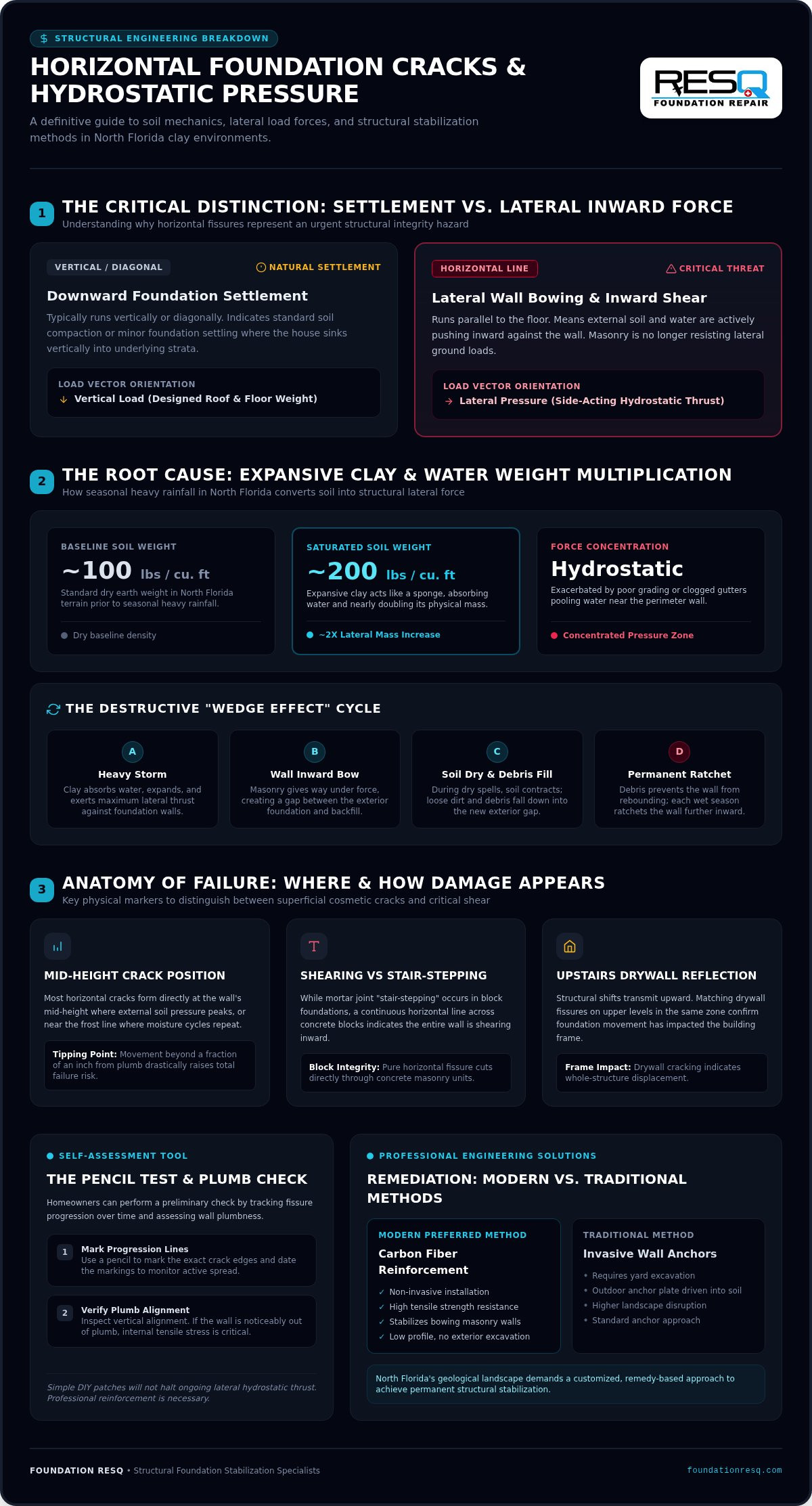
While vertical cracks often signal minor settlement, a horizontal crack is a different category of concern. These fissures run parallel to the floor and indicate that the wall is no longer effectively resisting the weight of the outside world. This isn’t about the house sinking. Instead, it’s about the ground pushing in. According to standard foundation engineering principles, foundations are designed to handle vertical loads from the roof and floors, but they have specific limits when it comes to lateral, or sideways, pressure.
Most horizontal cracks appear at the mid-height of the wall. This is often where the external soil pressure is most intense. You might also see them near the frost line where the ground regularly freezes and thaws. When these cracks appear, the wall is beginning to fail under the stress. Repairing horizontal foundation cracks becomes a structural priority once you notice the wall is no longer perfectly plumb. If the wall has moved more than a fraction of an inch, you’ve reached a structural tipping point where the risk of total failure increases.
The Anatomy of a Structural Foundation Crack
A structural crack isn’t just a surface scratch. In concrete block foundations, you might see “stair-stepping” where the crack follows the mortar joints, but a pure horizontal line across the blocks is even more concerning. It suggests the entire wall is shearing or bowing. Often, you’ll see matching symptoms upstairs. If your interior drywall is cracking in the same areas as the foundation issues below, the structural shift is already affecting the rest of your home’s frame. Identifying the width and depth of these fissures early can prevent more invasive repairs later.
Why Tallahassee’s Soil is a Major Factor
Our local geology in North Florida plays a massive role in these failures. Tallahassee is known for its expansive clay soils. These clays act like a sponge. During our heavy seasonal rains, the soil absorbs massive amounts of water, causing it to swell and increase significantly in weight. This volume change puts immense pressure on your foundation walls. Without proper drainage or reinforcement, the wall eventually gives way to this lateral force. This leads to the bowing and cracking that homeowners often discover after a particularly wet season. Understanding this soil behavior is the first step toward repairing horizontal foundation cracks for good.
The Root Cause: Hydrostatic Pressure and Lateral Force
While the composition of the soil provides the environment for foundation issues, water is the primary engine of destruction. When the ground surrounding your home becomes saturated after a heavy North Florida storm, the soil expands and exerts a massive amount of weight against your foundation. This phenomenon is known as hydrostatic pressure. Unlike the vertical weight of your home’s roof and floors, this pressure is lateral, meaning it pushes sideways against the exterior of your basement or crawl space walls.
Ignoring this lateral movement leads to long-term consequences that extend beyond the foundation. As the wall bows, it creates a “wedge” effect. Each time the soil dries and gets wet again, more debris falls into the small gaps behind the wall, preventing it from ever returning to its original position. Over several seasons, this cycle ratchets the wall further inward, eventually leading to structural instability that threatens the entire building frame.
How Water Weight Pushes on Your Walls
Wet soil is exponentially heavier than dry soil. In a typical Tallahassee landscape, a cubic foot of dry earth might weigh approximately 100 pounds. When that same soil becomes fully saturated, its weight can nearly double. This added mass translates directly into force against your concrete. Hydrostatic pressure is the primary driver of lateral wall failure. This force is often exacerbated by local drainage issues, such as clogged gutters or improper yard grading that directs rainwater toward the foundation rather than away from it. When water pools near the perimeter, it creates a concentrated zone of pressure that the original masonry was never designed to withstand.
The Difference Between Sinking and Bowing
It’s vital for homeowners to distinguish between vertical and lateral movement. Vertical or diagonal cracks usually indicate settlement, where the house is sinking into the earth because the soil beneath it cannot support the weight. In these scenarios, helical pier installation is often the gold standard for restoring vertical stability. However, horizontal cracks are a sign of deflection or bowing. This is a sideways failure rather than a downward one.
You can often identify bowing by looking for a “belly” or curve in the middle of the foundation wall. You might also notice the top of the wall leaning inward or the bottom shifting off the footer. Repairing horizontal foundation cracks requires tools that provide tensile strength to resist this sideways force. If you suspect your walls are beginning to deflect, you should request a professional structural evaluation to determine the exact nature of the movement before the damage progresses further.
Professional Repair Methods: Carbon Fiber vs. Wall Anchors
In the past, repairing horizontal foundation cracks often meant installing bulky steel I-beams that consumed valuable basement space. Modern structural engineering has shifted toward more efficient, low-profile reinforcements that offer permanent stability without the footprint of heavy machinery. While some homeowners attempt to use epoxy injection to seal these fissures, it’s vital to understand that epoxy is a sealant, not a structural brace. It cannot resist the massive lateral forces pushing against the wall. To stop a wall from bowing further, we must implement a solution that provides genuine tensile strength.
Choosing the right method depends on several variables. We evaluate the construction material of the wall, the severity of the inward deflection, and the accessibility of the exterior yard. For instance, a poured concrete wall with a minor bow may require a different approach than a block wall with significant displacement. Our goal is always to provide the most effective remedy with the least amount of disruption to your home’s interior.
Carbon Fiber Wall Reinforcement
Originally developed for aerospace applications, carbon fiber has become the gold standard for Carbon Fiber Wall Repair Tallahassee projects. This material is ten times stronger than steel in tension, yet it’s thinner than a penny. We bond these high-strength straps directly to the interior of the foundation wall using a specialized epoxy. This creates a permanent reinforcement that prevents any further inward movement. Because there is no excavation required, it’s the least invasive method available. Once installed, the straps are nearly flush with the wall and can be painted over, making it the ideal choice for finished living spaces.
Helical Tiebacks and Wall Anchors
When a wall has bowed significantly, we may need to use mechanical force to stabilize or even straighten the structure. Helical tiebacks and wall anchors are heavy-duty systems that extend through the foundation wall and anchor into the “competent” soil deep in your yard. These systems allow us to apply torque and pull the wall back toward its original position. While this method requires some exterior access, it provides the massive mechanical leverage needed to counteract extreme soil pressure. Whether your home requires stabilization or active straightening, these professional methods are the final line of defense in repairing horizontal foundation cracks. In many cases, structural issues necessitate additional work from a general contractor, and firms like The Martinez Company specialize in ensuring both residential and commercial projects maintain high standards of integrity.
Waiting and seeing is a common suggestion on internet forums, but it’s often the most expensive mistake you can make with your foundation. Unlike vertical settlement cracks that might remain dormant for years, horizontal fissures indicate an active, ongoing struggle between your wall and the earth. These cracks don’t heal themselves. If the soil pressure isn’t addressed, the wall will continue to move until the structural integrity is completely lost. When you’re considering the necessity of repairing horizontal foundation cracks, early detection is your best defense against a total wall failure.
A simple way to monitor progress is the “pencil test.” If you can fit the tip of a standard pencil into the crack, the wall has already experienced significant deflection. If the crack is wide enough to fit the entire pencil, you’re facing a structural emergency. Professional inspections differ significantly from a general home inspection. While a generalist might note the presence of a crack, a foundation specialist uses specialized tools to measure the exact degree of the bow and the integrity of the remaining masonry to determine the precise stabilization method required.
DIY Inspection Checklist for Homeowners
You can perform a preliminary assessment of your foundation’s health with a few basic tools. Use a four-foot level to check the plumb of your basement or crawl space walls. Even a small lean at the top or a “belly” in the middle confirms that the wall is failing under lateral pressure. Additionally, you should:
- Check the exterior: Look for gaps between the soil and the foundation or areas where water pools after a rainstorm.
- Inspect the top of the wall: See if the wooden sill plate is sliding off the concrete or if the floor joists are pulling away.
- Document everything: Take clear photos of the cracks with a ruler for scale. Note the date and weather conditions, as this record helps experts track the speed of the movement.
The Risks of Ignoring Horizontal Movement
The ultimate risk of ignoring these signs is total wall collapse. While this doesn’t happen overnight, the transition from a bowing wall to a collapsed one can be sudden once the structural limit of the masonry is reached. Before a collapse occurs, you’ll likely deal with secondary damage such as ruptured plumbing lines, cracked interior drywall, or shifted electrical conduits. In the Tallahassee real estate market, unaddressed structural issues can slash your home’s resale value by 20% or more. Buyers and lenders are wary of any property with visible structural failure. If you’ve discovered these warning signs, you should request a structural foundation inspection to secure your home’s future and prevent further damage.
The Foundation ResQ Solution: Stabilizing Tallahassee Homes for Good
At Foundation ResQ, we don’t just treat the visible symptoms of a bowing wall. Our approach begins with a comprehensive 360-degree evaluation of your home’s entire structural footprint. Because we’re experts in Tallahassee soil conditions, we understand that North Florida’s expansive clay requires specialized engineering strategies. We design customized plans that prioritize permanent structural health over temporary patches. By integrating moisture management with structural reinforcement, we ensure that the root cause of soil pressure is neutralized before it can cause further damage.
Our commitment to excellence is backed by our membership in the Groundworks network, providing us with access to industry-leading materials and proven engineering standards. We focus on providing transferable solutions that protect your home’s value and your family’s safety. The process of repairing horizontal foundation cracks is meticulous, and our team handles every stage with the precision required to restore your home’s integrity for the long term.
Our Proprietary Stabilization Process
We follow a disciplined, three-step methodology to ensure your foundation walls are fully stabilized and protected against future movement. Our technicians are trained to execute this remedy with minimal disruption to your daily life.
- Step 1: Precision cleaning and wall preparation. We prepare the masonry surface by removing debris, paint, or loose concrete. This ensures a perfect bond between the wall and the reinforcement materials.
- Step 2: High-strength epoxy bonding and strap application. We apply specialized, aerospace-grade carbon fiber straps using a high-performance epoxy. This creates a structural bond that is significantly stronger than steel.
- Step 3: Tensioning and final structural verification. Once the straps are secured, we verify the tension and alignment. This ensures the wall is fully supported and capable of resisting lateral soil forces indefinitely.
Long-term Protection and Peace of Mind
Structural repair is most effective when the environment around the foundation is controlled. We often recommend combining reinforcement with crawl space encapsulation Tallahassee services to manage humidity and prevent water from saturating the soil near your footings. This holistic approach creates a protective barrier between your property and the elements. Our solutions come with comprehensive structural guarantees, giving you the confidence that your home is secure. If you’ve noticed signs of wall failure, don’t wait for the problem to worsen. Schedule your free inspection with Foundation ResQ today to receive a professional assessment and a clear path to stabilization.
Securing Your Home’s Structural Future
A horizontal crack in your foundation is more than just a cosmetic blemish; it’s a clear signal that the soil surrounding your home is winning the battle against your walls. By understanding that hydrostatic pressure is the root cause, you can move away from temporary patches and toward permanent structural stabilization. Whether your property requires the low-profile strength of carbon fiber or the mechanical leverage of wall anchors, addressing these issues early is the only way to prevent a total wall failure and preserve your home’s resale value.
As Tallahassee’s local structural stabilization experts, Foundation ResQ provides the specialized knowledge needed to navigate North Florida’s unique geological challenges. Our Groundworks-backed transferable warranties and non-invasive carbon fiber solutions ensure that your home remains a safe, stable environment for years to come. Don’t let uncertainty put your investment at risk. Protect your home’s integrity—get a free foundation inspection from Foundation ResQ. Taking the first step in repairing horizontal foundation cracks today restores your peace of mind for tomorrow.
Frequently Asked Questions
Can I repair a horizontal foundation crack from the outside?
While you can address the root cause from the exterior by improving drainage or installing wall anchors, the crack itself is usually reinforced from the inside. Exterior excavation is sometimes necessary for certain mechanical anchors, but modern solutions like carbon fiber are applied directly to the interior wall face. This method is less disruptive to your Tallahassee landscaping and provides the tensile strength needed to stop further inward bowing.
Is a horizontal crack always structural?
Yes, horizontal cracks are almost always a sign of structural failure. Unlike vertical cracks that may result from minor shrinkage or settling, horizontal fissures indicate that the wall is bowing under lateral pressure. This movement suggests the wall’s integrity is compromised by external forces like Tallahassee’s expansive clay soils. You should treat any horizontal line in your foundation as a priority that requires a professional structural evaluation.
How much does it cost to fix a bowing foundation wall?
The cost of repair depends on the severity of the bow, the length of the crack, and the specific stabilization method required. A small section of carbon fiber reinforcement will differ in price from a full scale wall anchor installation involving exterior excavation. Because every home in North Florida has unique soil and structural conditions, we provide detailed inspections to determine the most effective and permanent solution for your specific property.
Can I use DIY epoxy kits for horizontal cracks?
You should not rely on DIY epoxy kits for horizontal fissures. Epoxy is an excellent sealant for stopping water leaks in non structural vertical cracks, but it lacks the tensile strength to resist lateral soil pressure. Repairing horizontal foundation cracks requires structural reinforcement like carbon fiber straps or wall anchors. Using a surface level patch only masks the problem while the wall continues to bow behind the scenes.
What happens if I ignore a horizontal crack in my basement?
Ignoring a horizontal crack often leads to total wall collapse. As Tallahassee’s wet seasons continue to exert hydrostatic pressure, the wall will bow further inward. This movement eventually reaches a tipping point where the masonry can no longer support the weight of the home above. Beyond the risk of collapse, repairing horizontal foundation cracks early prevents secondary damage like ruptured plumbing, electrical issues, and a substantial decrease in resale value.
Does homeowners insurance cover horizontal foundation crack repair?
Most standard homeowners insurance policies do not cover foundation repairs caused by earth movement or hydrostatic pressure. Insurance typically only pays for structural damage resulting from sudden, accidental events like a burst pipe or fire. Since horizontal cracks usually develop over time due to soil conditions and drainage issues, they are considered maintenance items. You should review your specific policy or speak with your agent to confirm your coverage details.
How long does carbon fiber wall reinforcement last?
Carbon fiber is a permanent solution designed to last for the life of your home. It doesn’t stretch, rust, or degrade over time, even in the humid environment of a Tallahassee crawl space or basement. When professionally installed with high strength epoxy, it creates a structural bond that is significantly stronger than steel. This durability is why we offer transferable warranties, providing long term security for both current and future homeowners.
Will foundation repair stop water from leaking through the crack?
Structural stabilization stops the movement that causes cracks, but it isn’t a standalone waterproofing solution. While we seal the cracks during the reinforcement process, we often recommend combining structural work with crawl space encapsulation or sump pump systems. This comprehensive approach addresses both the physical failure of the wall and the moisture issues that contribute to Tallahassee’s high hydrostatic pressure, ensuring a dry and stable foundation.