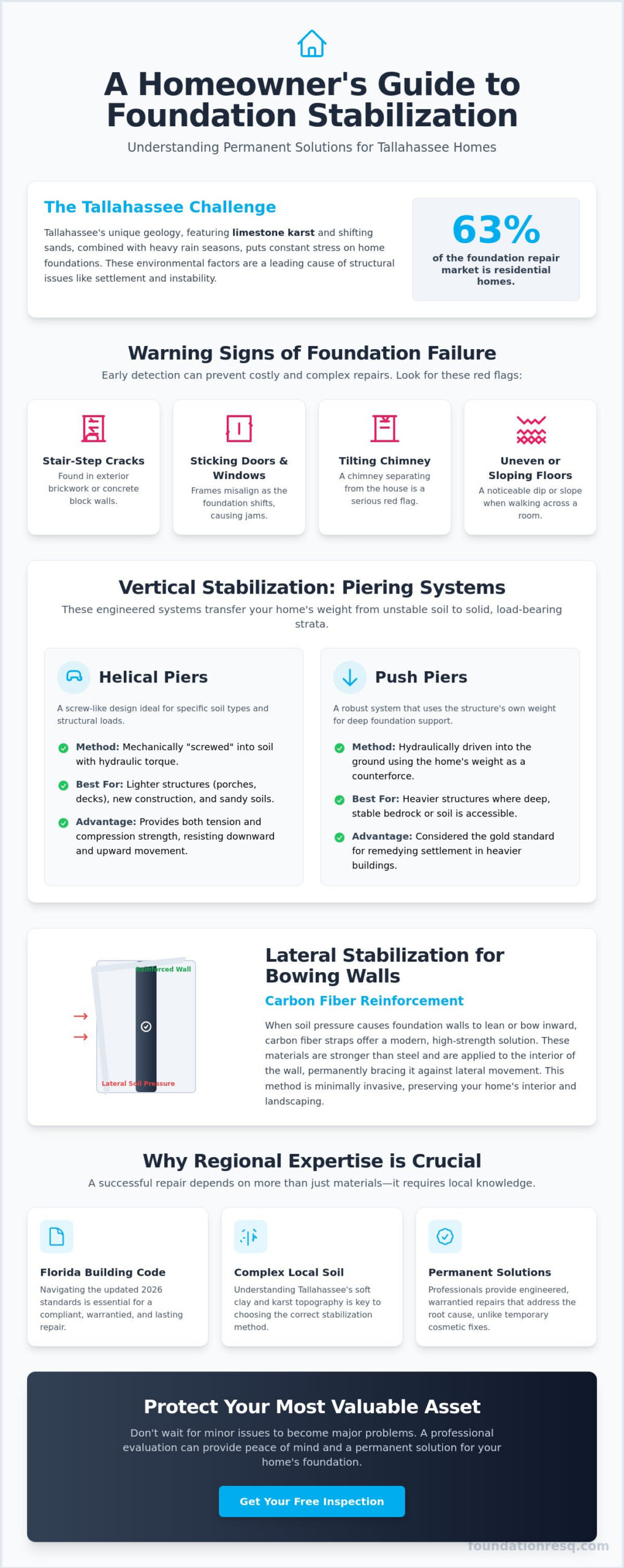
Imagine walking through your Tallahassee home and noticing a door that suddenly sticks or a new crack tracing the ceiling. It’s a quiet but unsettling realization that the limestone karst and shifting sands beneath your feet are affecting your home’s structural integrity. You aren’t alone in this concern, as the residential sector now accounts for over 63 percent of the foundation repair market. Achieving permanent foundation stabilization is about more than just a quick fix; it’s about anchoring your property to the right geological stratum to withstand Florida’s heavy rain seasons.
We understand the anxiety that comes with structural uncertainty and the confusion surrounding technical jargon like helical versus push piers. You deserve a solution that provides lasting peace of mind without the stress of high-pressure sales. In this guide, we’ll explore the most effective stabilization methods for 2026, including how updated standards in the Florida Building Code affect your property. You’ll learn how professional restoration can restore your home’s value and provide a warrantied defense against the elements.
Key Takeaways
- Distinguish between temporary cosmetic fixes and permanent structural solutions that address the root cause of home settlement.
- Evaluate the engineering differences between helical and push piers to find the right system for your property’s specific load-bearing requirements.
- Explore how carbon fiber wall reinforcement prevents lateral movement and secures leaning foundation walls using high-strength technology.
- Gain insight into how Tallahassee’s unique karst topography and intense rain cycles impact the necessity of professional foundation stabilization.
- Discover why regional expertise is vital for navigating the 2026 Florida Building Code and ensuring your structural repair is built to last.
What is Foundation Stabilization and Why is it Necessary?
Foundation stabilization is a precise engineering process designed to restore a home’s structural integrity. It works by transferring the weight of the building from unstable surface soils down to competent load-bearing strata or bedrock. Many homeowners initially view cracks in their drywall as a cosmetic nuisance. These are often symptoms of a deeper geological shift. Patching a crack might hide the problem for a season, but foundation stabilization addresses the root cause of the movement. Understanding Foundation engineering principles is essential for any homeowner dealing with the unique soil conditions found in North Florida.
As a Groundworks company, Foundation ResQ provides engineered, permanent remedies rather than temporary patches. In 2026, settlement repairs are expected to account for 36 percent of the foundation service market, highlighting the growing need for professional intervention. A home with a documented, warrantied stabilization system is a much safer investment than one with recurring settlement issues. This proactive approach acts as a protective barrier for your property and preserves your home’s resale value in a competitive market.
Stabilization vs. Foundation Replacement
Choosing stabilization is a more practical and cost-effective decision than a total foundation replacement. A full teardown and repour is incredibly disruptive and often requires you to vacate the property for weeks. Modern piering systems allow us to secure the home with minimal impact on your daily routine. These systems offer superior longevity compared to traditional concrete underpinning, which can eventually sink under its own weight in Tallahassee’s soft clay. Because the work is performed with surgical precision, your interior finishes and established landscaping remain largely undisturbed.
Common Signs Your Foundation Requires Immediate Stabilization
Identifying the need for help early can prevent more costly interventions later. In Tallahassee, one of the most recognizable signs is “stair-step” cracking in exterior brickwork or mortar. You might also notice doors and windows that suddenly stick or refuse to latch properly. It’s tempting to blame North Florida’s humidity for these issues, but they are frequently red flags for foundation settlement. Other serious indicators include chimneys that tilt away from the roofline or floors that feel noticeably uneven when you walk across a room. Early intervention is key. Addressing these symptoms ensures the long-term health of your property.
Comparing Piering Systems: Helical vs. Push Piers
When it involves vertical foundation stabilization, steel piering systems are widely considered the gold standard. The primary goal of these systems is to bypass the unstable upper layers of soil and anchor your home to a competent load-bearing stratum. In our region, this often means reaching past the expansive clays and organic matter that characterize Florida’s problem soils. By transferring the weight of your home to stable earth or bedrock, we create a permanent remedy for settlement. Foundation ResQ prioritizes the use of high-grade, galvanized steel for these components to ensure long-term corrosion resistance against North Florida’s high water table.
The choice between piering methods depends largely on the weight of the structure and the specific soil conditions present at your property. While both systems provide exceptional support, they rely on different engineering principles for installation. One uses mechanical torque to screw into the ground, while the other utilizes the weight of the building itself as a counterforce. Choosing the correct method is essential for a successful restoration project.
Helical Piers: The Solution for Lighter Structures and Sandy Soils
Helical piers feature a screw-like design with circular steel plates welded to the shaft. During installation, these piers are mechanically “screwed” into the soil using hydraulic torque motors. This design is unique because it provides both tension and compression strength, making it ideal for resisting both downward settlement and upward soil heave. We frequently recommend professional helical pier installation for lighter structures such as porches, decks, or as a proactive measure for new construction foundations. They are particularly effective in the sandy soil pockets found throughout the Tallahassee area where traditional driving methods might lack sufficient resistance.
Push Piers: Heavy-Duty Support for Settling Foundations
Push piers are designed for more substantial structural challenges. This system uses the existing weight of your home as a “reaction” force to hydraulically drive high-strength steel pier sections deep into the earth. The process continues until the piers reach bedrock or a verified stable soil layer. Because they rely on the building’s weight, push piers are the preferred choice for multi-story residential homes and heavy commercial properties. This method also offers the highest potential for “lifting” a home back toward its original level. If you’ve noticed significant sinking in a heavy masonry structure, a professional Push Pier Installation can often close cracks in brickwork and restore the home’s original profile while providing a permanent, warrantied solution for foundation stabilization.
Lateral Stabilization: Carbon Fiber and Wall Reinforcement
Lateral movement occurs when the soil outside your foundation exerts more pressure than the walls can withstand. This often results in foundation walls that bow inward or lean at the top. In North Florida, this is frequently caused by intense hydrostatic pressure from heavy rains saturating Florida’s problem soils. When these soils expand, they push against your home’s masonry with thousands of pounds of force. Carbon fiber has emerged as the industry standard for this specific type of foundation stabilization. It’s a high-tensile material that is significantly stronger than steel while remaining flexible enough to conform to your walls. For homeowners seeking carbon fiber wall repair in Tallahassee, this modern technology offers a permanent stop to wall movement. It creates a protective barrier that prevents the soil from compromising your home’s structural health.
Addressing lateral pressure is a critical step in preserving the long-term safety of your building. If left unmanaged, bowing walls can eventually lead to a total structural failure. By reinforcing the walls from the inside, we counteract the external weight of the earth without the need for massive reconstruction. This remedy-based approach focuses on the ultimate resolution of the physical issue, ensuring that the foundation remains a stable and reliable base for the rest of your home.
The Benefits of Carbon Fiber Straps
Carbon fiber straps provide a low-profile remedy that preserves the usable space and aesthetic of your home. These straps bond directly to the foundation wall using a specialized high-strength epoxy, creating a unified structural unit that cannot be stretched or broken. One of the most significant advantages for homeowners is the “no-dig” nature of the repair. Traditional wall anchors often require digging up your yard and disturbing established landscaping to place plates in the ground. Carbon fiber avoids this mess entirely. Once the installation is complete, the straps are nearly flat. You can easily paint over them or hide them behind finished drywall without losing square footage. You can find more specific installation steps in our homeowner’s guide to structural reinforcement.
When to Use Wall Braces vs. Carbon Fiber
The specific degree of wall bowing determines which stabilization method is the most effective. If a wall has shifted or bowed significantly, typically more than two inches, it might require the mechanical leverage of heavy-duty steel I-beams. These braces are anchored to the floor and the floor joists above, providing the necessary counterforce to stabilize a severely compromised structure. The choice depends on the amount of external soil pressure and the current state of the masonry. When evaluating different approaches, homeowners often note that carbon fiber wall reinforcement cost is often more favorable because it involves less labor and no heavy machinery. Our team carefully calculates the number of reinforcement points needed based on the unique geological challenges of your Tallahassee property to ensure a permanent, warrantied result.
The Tallahassee Factor: Soil, Rain, and Stability
Understanding local geology is vital for any homeowner in North Florida. Tallahassee is built upon a limestone karst platform. This means the ground beneath your home isn’t always a solid mass. Over time, water can dissolve limestone, creating underground cavities and even sinkholes. These geological shifts directly impact foundation stabilization because your home’s weight must be transferred past these unstable zones to reach truly solid ground. If your foundation rests on a pocket of limestone that has begun to erode, the structure will settle regardless of how thick the original concrete slab was.
North Florida’s weather patterns add another layer of complexity. Our heavy seasonal rains saturate the soil, causing it to expand and push against your structure. However, the dry spells that follow are just as dangerous. During these periods, the clay-heavy soils shrink and pull away from the foundation. This cycle creates a “pumping” effect that gradually weakens the home’s support. High local water tables also influence our choice of stabilization hardware. We use specific coatings and galvanized steel materials designed to resist the corrosive effects of constant moisture. This ensures that the protection we install today remains effective for the life of the home.
Moisture Management: The Invisible Partner of Stabilization
A stabilized foundation is only one part of a comprehensive structural remedy. If water pools in your crawl space, it can compromise the very soil we’ve anchored into. Consistent soil tension is essential for long-term stability. This is why crawl space encapsulation Tallahassee is often a necessary companion to piering. By sealing the area and using crawl space dehumidifiers and sump pump systems, we prevent rust on steel components and rot in wooden supports. This creates a controlled environment that protects your stabilization investment for decades. Maintaining a dry crawl space is the best way to ensure the ground remains stable and predictable.
Concrete Stabilization with PolyRenewal®
Foundation issues aren’t limited to the main structure of your home. Sinking slabs, cracked driveways, and uneven pool decks are common sights in Tallahassee due to soil erosion and karst-related voids. Traditional “mudjacking” often fails because it adds heavy weight to already unstable soil. We use PolyRenewal® for concrete leveling in Tallahassee. This lightweight, high-density foam expands to fill voids and stabilize the soil beneath the slab. It’s a waterproof, permanent solution that restores your property’s safety and curb appeal without the mess of traditional construction. This method addresses the root cause of the sinking by reinforcing the soil itself rather than just patching the surface.
Choosing a Stabilization Partner in Tallahassee
Selecting a contractor for foundation stabilization is a decision that affects the safety and value of your home for decades. It’s essential to work with a partner who understands the specific legal and environmental landscape of North Florida. For instance, the Florida Building Code, 9th Edition, takes effect on December 31, 2026. This updated code introduces strengthened foundation standards and revised wind speed maps. A local expert ensures your project meets these rigorous requirements while navigating the 30-business-day permit approval window now mandated for single-family homes under 7,500 square feet.
Many “one-size-fits-all” foundation companies apply the same techniques in Tallahassee that they use in different geological regions. This approach often fails here because it ignores our unique karst topography and expansive clay soils. A specialized local partner recognizes that a home in Killearn might require a different engineering plan than one in Southwood. We focus on the ultimate resolution of your home’s structural issues. This ensures the remedy is as permanent as the bedrock we anchor into, providing a protective barrier between your property and the elements.
The Foundation ResQ Inspection Process
Our diagnostic process is methodical and thorough. We don’t rely on guesswork or surface-level observations. Instead, we use high-precision laser levels and specialized mapping tools to document every millimeter of foundation movement. This data allows us to develop a custom stabilization plan tailored to your home’s unique footprint and soil conditions. Our team remains solution-focused rather than sales-focused. We prioritize identifying the root cause of settlement so that the proposed work provides a lasting structural defense.
Restoring Your Peace of Mind
Acting early to stabilize your foundation is a critical investment. Industry data indicates that foundation repair costs have risen by as much as 25 percent since 2020, according to Tallahassee Foundation Repair cost guides. This means waiting can lead to significantly higher expenses as structural issues worsen. We provide the reassurance of local Tallahassee roots backed by the national engineering strength of Groundworks. This combination ensures you receive personalized service alongside industry-leading technology and robust, long-term warranties. Our goal is to provide a comprehensive foundation stabilization strategy that leads you from a state of uncertainty toward a state of informed resolution.
Schedule your free foundation inspection with Foundation ResQ today to protect your property and restore your peace of mind.
Securing Your Home’s Structural Future
Your property is likely your most significant investment. Protecting it from the shifting limestone and expansive clay of North Florida requires a methodical approach that addresses the root cause of movement. We’ve explored how specialized helical and push pier technology provides a permanent anchor for your home, while carbon fiber reinforcement shields your walls from intense lateral pressure. Professional foundation stabilization isn’t just about structural repair; it’s about preserving the long-term health and market value of your property.
As a locally owned and operated Tallahassee team, we combine regional geological knowledge with the national strength of Groundworks-backed lifetime warranties. This unique combination ensures your home remains a safe haven even during Florida’s heaviest rain seasons. You deserve a solution that is as stable and reliable as the ground beneath your feet. Our experts are committed to providing the steady guidance you need to move from structural uncertainty toward a permanent resolution.
Secure your home’s future—Schedule your Free Foundation Inspection today!
You don’t have to face structural concerns alone. Let us help you restore your peace of mind and build a stable foundation for the years ahead.
Frequently Asked Questions
Is foundation stabilization a permanent fix?
Yes, professional foundation stabilization is a permanent solution. By using steel piers to transfer the home’s weight to stable bedrock or deep load-bearing soil, we bypass the unstable surface layers. This process is designed to provide a lifetime of structural integrity. Our Groundworks-backed solutions include long-term warranties that ensure your home remains protected against future settlement even during North Florida’s intense seasonal weather cycles.
How much does foundation stabilization cost in Tallahassee?
The cost of foundation stabilization varies based on the specific needs of your property. Factors such as the number of piers required, the depth needed to reach stable soil, and the accessibility of the site all influence the final investment. While every project is unique, addressing these issues early is always more cost-effective than waiting for structural damage to progress. A professional inspection is the only way to get an accurate assessment for your home.
Can I live in my house while the stabilization work is being done?
You can absolutely remain in your home throughout the entire installation process. Most foundation stabilization work is performed from the exterior of the building. Our teams work methodically to ensure minimal disruption to your daily routine and established landscaping. Because we don’t require a total foundation teardown, the project is significantly less invasive than a full replacement. You’ll have full access to your living spaces while we secure the structure.
Does homeowners insurance cover foundation stabilization?
Standard homeowners insurance policies typically do not cover foundation stabilization. Most policies exclude damage caused by earth movement, settlement, or hydrostatic pressure. However, coverage might apply if the damage resulted from a sudden, covered peril like a major plumbing failure. In Florida, sinkhole coverage is a separate consideration that homeowners should discuss with their provider. We recommend reviewing your specific policy details to understand your coverage limits.
What is the difference between foundation repair and foundation stabilization?
Foundation repair is a broad category that can include everything from minor crack patching to major structural work. Foundation stabilization specifically refers to the engineering process of stopping a building from sinking or shifting. While cosmetic repairs hide the symptoms, stabilization addresses the root cause by anchoring the home to stable geological strata. Stabilization is a structural remedy that ensures the permanence and safety of the building.
How long does the installation of helical or push piers take?
Most piering installations are completed within one to three business days. The exact timeline depends on the number of helical or push piers your home requires and the depth of the stable soil layers beneath your property. Our teams use specialized hydraulic equipment to ensure a precise and efficient installation. We prioritize a steady and deliberate pace to guarantee the structural integrity of every pier we place.
Will stabilizing my foundation fix the cracks in my drywall?
Stabilization stops the movement that causes drywall cracks and may even close some of them during the lifting process. However, stabilization is a structural remedy rather than a cosmetic one. Once the foundation is secure and the home is level, you’ll still need to patch and paint any existing cracks to restore the interior appearance. We recommend waiting several weeks after the stabilization is complete to ensure the structure has fully settled into its new, permanent position.
What happens if I ignore signs of foundation settlement?
Ignoring signs of foundation settlement leads to progressive structural damage and significantly higher repair costs. Small cracks in brickwork or sticking doors are early warning signs that the ground is shifting beneath you. Over time, these issues can evolve into leaning chimneys, major wall bowing, or total structural failure. Proactive intervention preserves your home’s value and provides essential protection against Tallahassee’s unique geological challenges and heavy rains.