In the unique geology of the Sunshine State, a small crack in your drywall is rarely just a cosmetic eyesore; it’s often a silent warning from the ground beneath your feet. You’ve likely noticed a door that sticks or a gap near your baseboards and wondered if it’s just the house “settling” or something more serious. It’s natural to feel anxious when you can’t tell the difference between normal age and a looming structural failure, especially with Florida’s unpredictable Red Hills clay and sandy coastal soils. Learning the specific signs of foundation problems in Florida homes is the first step toward protecting your property’s value and your family’s safety.
This 2026 guide will show you how to identify these red flags before they escalate into the kind of catastrophic damage that threatens your home’s integrity. We’ll walk through a clear checklist of symptoms, explain why our local soil behaves this way, and outline the path toward a permanent, professional stabilization. By understanding the difference between cosmetic shifts and structural threats, you can act with confidence to preserve the house you love.
Key Takeaways
- Understand how Florida’s unique karst topography and Tallahassee’s Red Hills clay create specific signs of foundation problems in Florida homes that differ from other regions.
- Learn to identify external structural shifts, such as stair-step cracks in brickwork and chimneys that have begun to pull away from the main exterior wall.
- Recognize interior warning signs including diagonal drywall cracks and doors that no longer latch, which often signal a shift in the home’s underlying support.
- Discover why spongy floors and persistent musty odors in your crawl space are critical indicators of moisture-driven structural instability.
- Explore how professional remedies like helical or push pier installations provide a permanent solution by bypassing unstable topsoil to secure your home in 2026.
Understanding the Florida “Foundation Tax”: Soil and Climate Factors
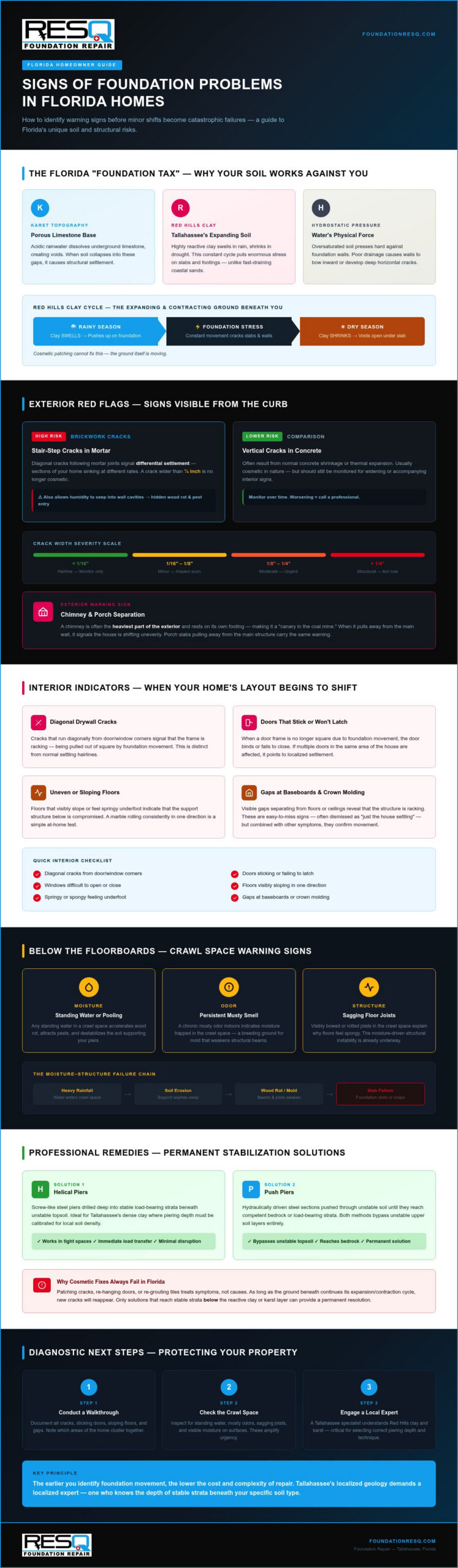
Florida homeowners often face what many industry professionals call a “foundation tax,” an inevitable cost of maintaining a home built on one of the most geologically volatile landscapes in the country. Much of the state sits on karst topography, which is a landscape characterized by porous limestone. Over time, acidic rainwater filters through the ground and dissolves this limestone, creating underground voids and channels. When the soil above these voids shifts or collapses into the gaps, it leads to structural settlement that manifests as visible signs of foundation problems in Florida homes.
In Tallahassee, the challenge is compounded by the presence of “Red Hills” clay. Unlike the fast-draining sands found along the coast, this clay is highly expansive and reactive to seasonal humidity. It acts like a dense sponge, swelling significantly during humid, rainy months and shrinking during dry spells. This constant cycle of expansion and contraction puts immense stress on a home’s concrete slab or footings. Because the ground is physically moving, attempting to fix the resulting cracks with cosmetic patches is a temporary measure that fails to address the underlying instability.
Heavy North Florida rainfall also plays a critical role in soil erosion. Intense storms can wash away the supporting soil from beneath a concrete slab, leaving sections of the foundation suspended over empty pockets of air. Without consistent support, the weight of the structure eventually causes the concrete to snap or sink, leading to the structural failures homeowners dread.
The Role of Hydrostatic Pressure
When our region experiences heavy downpours, the soil surrounding your home becomes oversaturated. This water doesn’t just sit in the ground; it exerts significant physical force against your home’s lower levels. Hydrostatic pressure is the force of water against a structure. In homes with crawl spaces, this pressure often pushes against the foundation walls from the outside. If your property has poor drainage, the sheer weight of the water-logged soil can cause walls to bow inward or develop deep horizontal cracks, indicating that the foundation’s integrity is being compromised by the environment.
Tallahassee’s Unique Geological Profile
Tallahassee sits at a geological crossroads that requires specialized knowledge to navigate. While coastal areas primarily deal with shifting sands that erode easily, our inland location features dense clay deposits that hold moisture for much longer periods. These specific soil types dictate the technical approach to stabilization. For instance, the density of the clay may require different piering depths or equipment compared to a sandy lot. Recognizing the signs of foundation problems in Florida homes requires this localized perspective. A steadfast local expert understands that a permanent remedy must bypass these unstable upper soil layers to reach the competent load-bearing strata deep underground.
Exterior Red Flags: Identifying Structural Shifts from the Curb
Walking around your property provides a clear view of how your home is interacting with the ground. Because of Florida’s specific soil challenges, exterior materials often show stress before interior walls do. Identifying these signs of foundation problems in Florida homes early can prevent minor shifts from becoming total structural failures. Your home’s exterior acts as a protective shell, and any disruption to that shell is a primary indicator of movement beneath the surface.
Stair-Step Cracks vs. Vertical Cracks
Vertical cracks often happen because of simple concrete shrinkage or thermal expansion, which are common and usually cosmetic in nature. However, “stair-step” cracks follow the mortar lines in a diagonal pattern and signal that one corner of the house is losing its footing. This is a classic example of differential settlement, where parts of the structure are sinking at different rates. If you find a crack wider than 1/4 inch, it’s no longer just a surface issue. These openings are also dangerous because they allow Florida’s heavy humidity to seep into your wall cavities, potentially causing hidden wood rot or attracting pests.
Chimney and Porch Separation
When a chimney begins to pull away from the main structure, it creates more than just a foundation concern; it also poses a risk to the fireplace’s internal safety. For those looking for expert guidance on fireplace integrity during such shifts, Home Safe Hearth & Chimney serves as a premier resource for comprehensive chimney inspections and care.
A chimney is often the heaviest part of a home’s exterior and typically rests on its own footing. This makes it a “canary in the coal mine” for structural health. If you see a gap opening between the chimney stack and your siding, it’s one of the most reliable signs of foundation problems in Florida homes. This type of movement usually requires helical pier installation to reach deeper, stable soil and pull the stack back into its original position. You might also see gaps between your porch slab and the main foundation, which happens when the soil beneath these heavy concrete elements compresses or erodes over time.
Beyond the brickwork, look for gaps forming around window frames or exterior door casings. If you notice that your fascia board is pulling away at the roofline, it often means a corner of the foundation is dropping, causing the entire frame of the house to twist or torque. In 2026, homeowners shouldn’t ignore these subtle shifts. If you’re seeing these red flags, seeking permanent foundation stabilization can stop the damage before it becomes a much larger financial burden.
Interior Indicators: When Your Home’s Layout Begins to Shift
While exterior cracks are visible from the curb, the interior of your home often provides the most immediate evidence of structural movement in your daily life. These internal shifts disrupt the precision of your home’s layout, affecting everything from how a door closes to how level your kitchen table feels. Recognizing these interior signs of foundation problems in Florida homes allows you to act before the frame of the house undergoes permanent distortion. When the ground beneath your slab or crawl space shifts, the rigid materials of your home must bend or break to accommodate that movement.
The Sticking Door Test
Florida’s high humidity is famous for swelling wood doors, but there’s a distinct difference between seasonal swelling and structural frame racking. If a door sticks only during the peak of summer and moves freely in the winter, it’s likely a moisture issue. However, if you notice a consistent gap at the top of the door frame that’s wider on one side than the other, your home’s frame is no longer square. You might also find doors that swing open or shut on their own, or latches that no longer line up with the strike plate. Re-hanging or trimming a door only masks the symptom; it doesn’t stop the foundation from sinking further into the Tallahassee clay.
Drywall Cracks and Ceiling Gaps
Drywall is a brittle material that quickly reveals when a wall is under stress. You should look specifically for diagonal cracks that start at the upper corners of door and window frames. These “stress fractures” indicate that one side of the wall is being pulled down faster than the other. Another subtle indicator is the “nail pop,” which appears as a small, circular bump or hole where a drywall screw is pushing through the paint. This happens when the wall studs shift or twist due to structural pressure. If you’ve patched these cracks only to have them reappear in the same spot months later, it’s a major red flag that the building is still moving. Once the structure is stabilized, professional contractors like Chaparro’s Painting, LLC can restore the interior by properly repairing and refinishing those damaged drywall surfaces.
While cracks in drywall and sticking doors are obvious interior indicators, the space beneath your home often hides the most aggressive signs of foundation problems in Florida homes. For houses built on crawl space foundations, the structural integrity of the entire building depends on the health of the wooden support system. If you notice floors that feel bouncy, spongy, or visibly sag in the center of a room, the floor joists below are likely losing their ability to carry the home’s weight. These subtle shifts in the floor’s feel are often the first physical warning that the environment below has become unstable.
The Impact of Moisture on Structural Integrity
High humidity levels, common throughout the Florida Panhandle, act as a slow-moving catalyst for structural failure. When moisture remains trapped in a crawl space, wooden supports begin to soften and lose their rigidity. This progression from simple dampness to active wood rot eventually leads to the sagging floors homeowners experience in their living areas. Standing water or excessive condensation on crawl space walls are clear indicators that the soil is oversaturated. Implementing crawl space encapsulation in Tallahassee serves as a vital preventative remedy, sealing the environment against the elements and protecting the home’s primary supports for years to come.
Identifying Wood Rot and Mold
Identifying wood rot early is essential for maintaining the load-bearing capacity of your foundation. You should look for “white rot,” a type of fungus that breaks down the structural components of wood, leaving beams looking bleached and feeling soft to the touch. Once a support beam is compromised by rot, its strength cannot be restored by simply drying it out. Additionally, the “Stack Effect” ensures that air from your crawl space doesn’t stay there; instead, it moves upward into your living space, carrying musty odors and mold spores with it. This natural airflow pattern means that if you can smell a problem in your living room, the structural wood below is already at risk.
In 2026, protecting your property investment requires a dual approach of mold remediation and permanent moisture control. If you’ve noticed spongy floors or a persistent musty scent, it’s time to seek a permanent stabilization remedy before the damage spreads to the rest of your home’s frame. Addressing these below-ground issues is the final line of defense for your home’s long-term health and safety.
Diagnostic Next Steps: Protecting Your Tallahassee Property Investment
Recognizing the signs of foundation problems in Florida homes is a vital first step, but the true value lies in how you respond to these warnings. In 2026, the “wait and see” approach is often the most expensive choice a homeowner can make. Because our local geological conditions don’t stabilize on their own, minor settlement today can evolve into significant structural failure by next season. Addressing these issues early doesn’t just fix a crack; it preserves your home equity and ensures the long-term safety of your building’s frame. Professional intervention moves you away from uncertainty and toward a documented, permanent remedy.
Permanent Stabilization Solutions
Modern structural repair focuses on bypassing the unstable topsoil that causes so much trouble in the Florida Panhandle. Helical and push piers are engineered to transfer the weight of your home from the shifting Tallahassee clay down to stable, load-bearing strata deep underground. This process provides a permanent bypass to the environmental factors that lead to settlement. For homes experiencing inward movement in their lower levels, carbon fiber wall repair offers a low-profile, high-strength reinforcement that stops bowing in its tracks.
These engineered solutions are far superior to temporary methods like “concrete pressing” or traditional mudjacking, which often add more weight to already failing soil. For sunken concrete slabs, such as driveways or pool decks, we utilize PolyRenewal® technology. This modern, non-invasive solution involves injecting a high-density polyurethane foam beneath the concrete. The foam expands to fill voids and lift the slab back to its original position, while also waterproof-sealing the soil beneath to prevent future erosion.
Choosing a Specialized Local Contractor
When dealing with structural integrity, the expertise of your contractor is just as important as the technology they use. Working with a Groundworks-backed company like Foundation ResQ provides the peace of mind that comes from a national network of structural engineers combined with deep, localized knowledge of Tallahassee’s unique soil challenges. We don’t just look at the symptoms; we analyze the entire environment of your property to provide a comprehensive stabilization plan.
During a professional foundation inspection, you can expect a thorough evaluation of both the interior and exterior of your home. Our experts will identify the root cause of the movement and explain the specific engineering required to restore your home’s health. Taking this step today protects your property from the unpredictable nature of our local climate. If you’ve identified any signs of foundation problems in Florida homes on your own property, it’s time to secure your investment. Schedule your professional foundation inspection today to begin the path toward a permanent structural resolution.
Securing Your Home’s Structural Future in 2026
Understanding the unique geological challenges of North Florida is the first step toward responsible homeownership. From the expansive Red Hills clay to the hidden limestone voids of karst topography, the ground beneath your home is in a constant state of flux. Early detection of the signs of foundation problems in Florida homes, such as diagonal drywall cracks or spongy floors, allows you to address structural shifts before they impact your property’s equity or safety.
Instead of temporary cosmetic patches, focus on permanent stabilization remedies that bypass unstable topsoil. Our team of local Tallahassee structural specialists utilizes Groundworks-backed technology, including expert helical pier installation and PolyRenewal concrete lifting, to provide lasting protection. This methodical approach ensures your home remains a stable sanctuary regardless of seasonal humidity or heavy rainfall cycles.
Don’t let structural uncertainty linger. Protect your home today: Schedule a Free Foundation Inspection with Foundation ResQ. Taking action now provides the peace of mind that comes from a professional, long-term solution.
Frequently Asked Questions
Is it normal for a Florida house to have some foundation cracks?
Small hairline cracks are common in concrete, but they shouldn’t be ignored if they grow or change shape. In our region, stair-step cracks in brick or diagonal drywall fractures are clear signs of foundation problems in Florida homes. These patterns indicate that the soil is no longer supporting the weight of the structure evenly. While some settling is expected, any crack wider than one-eighth of an inch warrants a professional evaluation to ensure the building’s safety.
How much does foundation repair typically cost in Florida?
Costs for structural remediation vary significantly based on the specific geological challenges of your property and the number of piers required for stabilization. Factors like the depth of the Tallahassee clay and the extent of the structural shift influence the final scope of work. Because every home sits on a unique patch of karst topography, a professional inspection is the only way to determine the precise remedy needed to restore your home’s integrity and value.
Can I sell a Florida home with foundation problems?
You can sell a home with structural issues, but Florida law requires you to disclose any known material defects to potential buyers. Foundation problems often lower property value and can make it difficult for buyers to secure traditional financing. Completing permanent repairs before listing your home often preserves a significant portion of its equity. Many homeowners find that providing a transferable warranty for pier installation makes the property much more attractive to cautious buyers.
What is the most common cause of foundation failure in Tallahassee?
The primary cause of failure in our area is the combination of expansive Red Hills clay and karst topography. This clay swells when wet and shrinks when dry, creating a constant “push-pull” effect on your footings. Additionally, the underlying limestone can dissolve over time, creating voids that lead to sudden shifts. These environmental factors are why identifying the early signs of foundation problems in Florida homes is critical for long-term property health.
How long does professional foundation repair take to complete?
Most residential stabilization projects, such as installing helical or push piers, are completed within one to three days. Our teams work efficiently to minimize disruption to your daily routine while ensuring technical precision. More complex projects involving crawl space encapsulation or extensive mold remediation might require additional time. We provide a clear timeline after the initial inspection so you know exactly what to expect during the restoration and protection process.
Does homeowners insurance cover foundation repair in Florida?
Standard homeowners insurance policies in Florida typically don’t cover repairs for gradual settling or soil expansion. However, state law requires insurers to cover “catastrophic ground cover collapse,” and they must offer optional coverage specifically for sinkhole damage. It’s important to review your policy details with your agent to understand your specific protections. Most structural maintenance and stabilization are considered the homeowner’s responsibility to prevent long-term damage from environmental wear.
What happens if I ignore the signs of foundation movement?
Ignoring structural movement leads to a progression of damage that becomes increasingly expensive to fix. Small cracks eventually become large gaps that allow moisture and pests to infiltrate your wall cavities. Over time, the frame of your house can become permanently warped, leading to broken window seals and compromised rooflines. Acting early prevents a manageable stabilization project from turning into a major structural failure that threatens the safety and value of your investment.
Can heavy rain cause immediate foundation damage?
Intense rainfall can cause immediate issues by rapidly eroding the supporting soil from beneath your concrete slab. In Tallahassee, heavy storms also increase hydrostatic pressure, which is the physical force of saturated soil pushing against your foundation walls. This pressure can lead to sudden bowing or cracking, especially in homes with crawl spaces. Proper drainage and professional stabilization systems act as a final line of defense against these sudden, weather-driven structural threats.