What if being completely honest about your home’s structural history was the fastest way to close a deal rather than the quickest way to lose it? Selling a property in the Sunshine State often feels like walking a tightrope, especially when you have invested in major repairs. You likely worry that mentioning a past stabilization project will scare off buyers or slash your asking price. It is a common fear, but silence is often far more expensive than transparency.
This guide will show you how following the foundation repair disclosure laws Florida requires can actually become your strongest selling point. By documenting your home’s stability, you transform a perceived liability into a certified asset that protects your equity and shields you from post-closing lawsuits. You don’t have to choose between a successful sale and legal safety.
We will examine the 2026 legal standards established by cases like Johnson v. Davis, the reality of “As-Is” contracts, and how permanent solutions like helical piers provide the documentation you need for a smooth closing. You will gain the clarity needed to present your home as a secure, long-term investment for any buyer. This methodical approach ensures your property remains protected and your sale remains final.
Key Takeaways
- Understand why the landmark Johnson v. Davis ruling means you must disclose any known structural issues that materially affect your home’s value.
- Clear up the confusion surrounding “As-Is” contracts by learning how foundation repair disclosure laws Florida mandate honesty even when selling a property in its current condition.
- Identify the specific signs of structural distress caused by Florida’s Karst topography that require legal disclosure to avoid post-closing litigation.
- Learn how to navigate the pre-listing process with professional inspections and documentation that protect your home equity and streamline the sale.
- Discover how permanent stabilization with transferable warranties can transform a past repair into a verified asset that reassures potential buyers.
The Legal Standard for Florida Real Estate: Understanding Johnson v. Davis
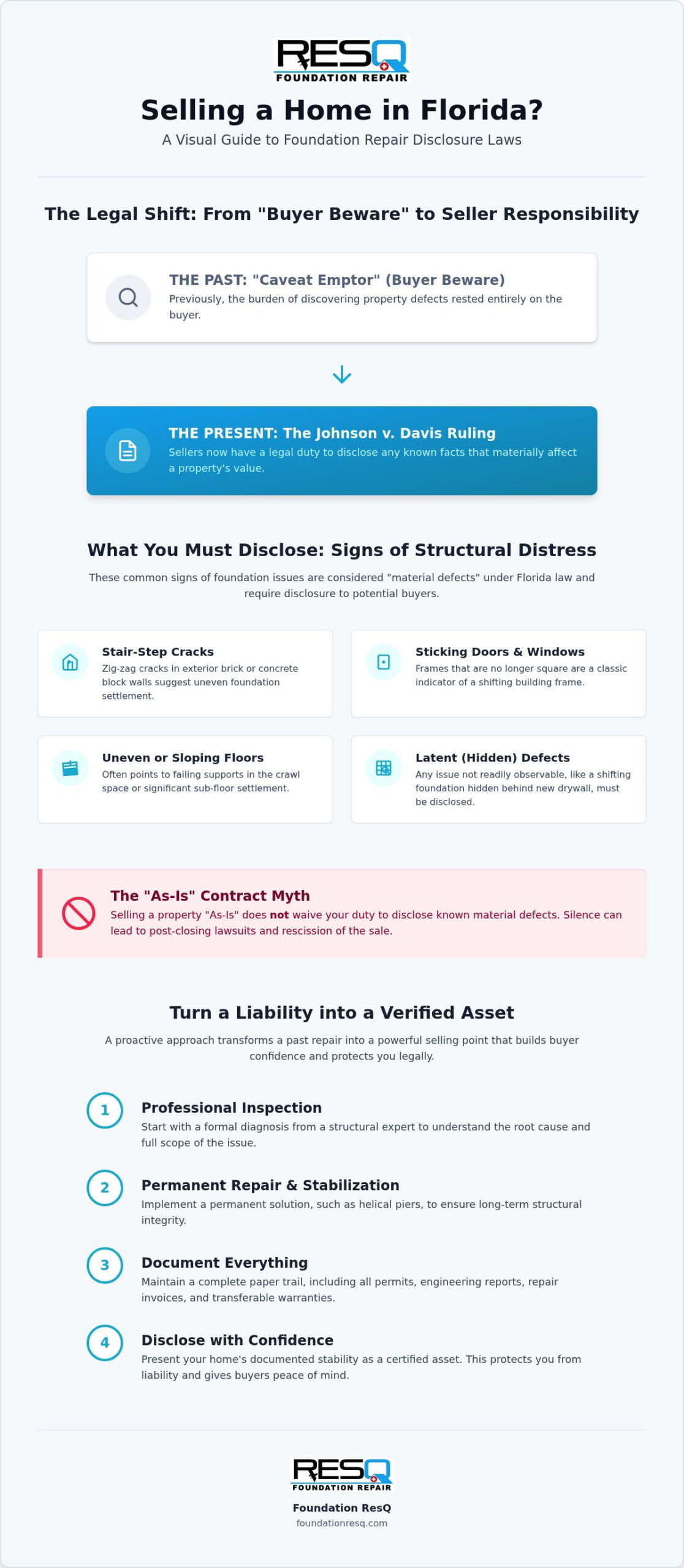
For decades, Florida real estate followed the principle of “Caveat Emptor,” or “let the buyer beware.” This meant the burden of discovery sat entirely on the purchaser’s shoulders. Everything changed with the landmark Supreme Court of Florida ruling in Johnson v. Davis. This case fundamentally reshaped the foundation repair disclosure laws Florida homeowners must follow today. The court decided that a seller cannot remain silent when they know about a defect that significantly impacts the home’s value.
The Johnson v. Davis standard requires Florida residential sellers to disclose all known facts that materially affect the value of a property and are not readily observable by a buyer.
This duty is non-negotiable. Even if a buyer never asks about the slab or the crawl space, you’re legally obligated to provide the information. Failing to meet this standard can lead to a lawsuit for fraudulent concealment or the complete rescission of the contract long after the closing date.
The Shift from Buyer Beware to Seller Responsibility
In the modern Florida market, the law prioritizes transparency to protect buyers from hidden structural failures. If you’re aware of a sinking corner or a history of unstable soil on your lot, you must include this in your seller disclosure statement. Honesty isn’t just a moral choice; it’s the most cost-effective legal strategy available. Attempting to hide a defect often results in damages that far exceed the cost of the original repair. When you disclose a problem that’s been professionally stabilized, you transition from a position of legal vulnerability to one of documented integrity. This shift ensures that the buyer is making an informed decision and the seller is protected from future litigation.
What Qualifies as a “Known Fact” Under Florida Law?
Florida courts distinguish between “patent” defects, which are obvious to anyone walking through the home, and “latent” defects, which are hidden from view. A hairline crack in a garage floor might be patent, but a shifting foundation hidden behind new drywall is latent. Under foundation repair disclosure laws Florida sellers are held to what they “should have known” based on their history with the property. If you’ve previously pulled permits for push pier installation or received an inspection report detailing settlement, those documents create a permanent paper trail. You can’t claim ignorance of a condition that’s been formally diagnosed or repaired. In areas like Tallahassee, where Karst topography creates unique geological risks, being proactive with your documentation is essential. Instead of fearing this history, use your repair invoices to prove the structure is now permanently stabilized.
Defining Material Defects: What Foundation Issues Must You Disclose?
In the context of Florida real estate, a material defect is any condition that would significantly lower a property’s value or impact a buyer’s decision. Under the foundation repair disclosure laws Florida mandates, this includes any evidence of structural instability. Tallahassee homeowners face a unique challenge due to the region’s Karst topography. In this geological setting, the underlying limestone can dissolve over time, creating underground voids that cause the soil to shift. This leads to “active settlement,” a progressive threat to a building’s stability. While “historic settling” refers to a home that has already reached a point of rest, active movement is a current defect that must be shared with potential buyers.
Structural Signs That Require Disclosure
You don’t need to be an engineer to identify signs that require transparency. Look for stair-step cracks in your exterior brickwork or foundation blocks. These patterns suggest that one portion of the house is sinking at a different rate than the rest. Inside the home, windows that stick in their frames or doors that no longer latch properly are classic indicators of a shifting frame. If you notice uneven or sloping floors, it often points to a failure in the existing pier system or significant sub-floor settlement. These symptoms directly impact the desirability of the home and fall under mandatory disclosure requirements. Documenting these issues early allows you to address them with a permanent stabilization plan before they become a hurdle during the closing process.
Crawl Space and Moisture Concerns
Florida’s high humidity makes the crawl space a primary area for structural concern. Standing water or persistent dampness can weaken the wood joists that support your entire home. This is especially critical under the new flood disclosure law, which emphasizes the need for transparency regarding water-related issues in residential transactions. Excess moisture often leads to wood rot and fungal growth, making mold remediation Tallahassee FL a necessary step to restore the home’s structural integrity. If you’ve experienced these issues, disclosing the remedy, such as crawl space encapsulation, shows a buyer that you’ve taken a proactive stance on protection. Understanding these foundation repair disclosure laws Florida homeowners must follow helps you prepare for a successful, legally compliant sale. If you’re unsure if a crack is structural or cosmetic, a professional assessment from Foundation ResQ can provide the clarity you need before listing your property.
The “As-Is” Contract Myth and Post-Closing Liability
A common misconception in the Florida real estate market is that selling a home “As-Is” provides a shield against liability for structural issues. Many homeowners believe that by checking the “As-Is” box on a FAR/BAR contract, they’re released from the obligation to mention past or present foundation movement. This is a dangerous legal misunderstanding. Under foundation repair disclosure laws Florida courts have consistently ruled that an “As-Is” clause only indicates the seller’s intent not to perform repairs or offer credits. It doesn’t override your duty to disclose known latent defects that materially affect the property’s value. If you know the soil beneath your home is shifting, the contract language won’t excuse your silence.
Why “As-Is” Isn’t a Get-Out-of-Jail-Free Card
The legal distinction between selling a home in its current condition and concealing a structural failure is sharp. Florida law requires transparency regarding any defect that a buyer cannot easily see during a standard walkthrough. If you’ve covered up stair-step cracks with fresh paint or failed to mention a history of settlement, the “As-Is” contract won’t protect you in court. Most transactions utilize the Seller’s Property Disclosure Statement (SPIS). This document is where you must formally record the home’s structural history. When you’re honest on this form, you shift the risk to the buyer, who then chooses to proceed with full knowledge of the property’s state. This transparency actually facilitates a smoother closing because it removes the threat of “surprises” during the buyer’s inspection period.
The Financial Risk of Non-Disclosure
The consequences of failing to follow foundation repair disclosure laws Florida requirements are often far more expensive than the repairs themselves. If a buyer discovers a hidden structural issue after closing, they may sue for fraudulent concealment. These legal disputes can drag on for years, resulting in massive attorney fees and the potential rescission of the sale. This means you could be forced to take the house back and return the full purchase price. In cases of intentional fraud, Florida courts can even award punitive damages. These are additional financial penalties designed to punish the seller. A pre-listing inspection from a qualified specialist acts as your best legal defense. By identifying and documenting issues before you hit the market, you can provide a clear record of the home’s condition. This proactive step protects your equity and ensures that once the papers are signed, the sale is final.
A Seller’s Roadmap: Navigating Inspections and Disclosures in 2026
As we move into 2026, the regulatory environment for Florida homeowners has become increasingly precise. Proactive management is the only way to satisfy foundation repair disclosure laws Florida requires while maintaining your home’s market value. Instead of waiting for a buyer’s inspector to find a problem, you should control the narrative by identifying and resolving structural concerns before the first “For Sale” sign hits the lawn. This roadmap ensures that your structural history becomes a documented asset rather than a liability.
The Pre-Listing Structural Evaluation
Hiring a professional for foundation repair Tallahassee before you list your property is a strategic financial move. It allows you to obtain a clear remediation plan on your own timeline, preventing frantic last-minute negotiations. You should understand the difference between a structural engineer and a repair specialist. An engineer provides the diagnostic specifications, while a specialist like Foundation ResQ executes the remedy using industrial-grade helical or push pier systems. Under 2026 regulations, such as HB 913, repairs identified in milestone inspections must begin within 365 days. By completing these repairs early, you can present your home with a “clean bill of health.” Framing a past repair as a proactive maintenance win shows the buyer that the structure is permanently stabilized and protected from future movement.
Mastering the Disclosure Statement
The language you use in your Seller’s Property Disclosure Statement (SPIS) is critical for legal protection. Avoid vague terms like “fixed a crack.” Instead, use technical precision to describe the stabilization. Use phrases like “permanently stabilized via industrial-grade push pier installation” to instill confidence. To fully comply with foundation repair disclosure laws Florida mandates, you should attach all supporting documentation to your disclosure package, including:
- The original structural engineering report.
- Finalized building permits (required for all structural work regardless of cost).
- Transferable warranty documents from a reputable provider.
- Proof of final inspection and project closure.
Ensuring the buyer signs a specific acknowledgment of these disclosures limits your future liability. This methodical approach creates a transparent paper trail that justifies your asking price and protects your equity. If you are preparing to list your home and need to verify its structural integrity, schedule a structural assessment to secure the documentation you need for a smooth closing.
Turning Structural Concerns into Verified Assets with Professional Repair
Navigating the foundation repair disclosure laws Florida enforces doesn’t have to be a defensive struggle. Instead, think of professional remediation as a way to convert a structural question mark into a certified asset. When you provide a buyer with a home that’s already been stabilized, you eliminate the uncertainty that often kills real estate deals. A property with a documented repair history and a transferable warranty is frequently more attractive than a home with unknown soil conditions. You aren’t just selling a house; you’re selling a permanent remedy.
Remediation vs. Price Reduction
Many sellers hesitate to invest in repairs, opting instead to offer a price reduction. This is often a costly mistake. Buyers typically demand a “scare discount” that far exceeds the actual cost of stabilization because they’re accounting for the worst-case scenario. Professional repairs eliminate this “unknown” factor for both the buyer and their lender. Most insurers in the 2026 market require proof of structural integrity before issuing a policy. By positioning your home as “stabilized and warrantied” in the MLS, you attract a wider pool of qualified buyers who appreciate the transparency. It’s much easier to defend your asking price when you have industrial-grade proof of the home’s health.
The Foundation ResQ Advantage for Sellers
Achieving a smooth sale requires the right technical solutions and the paperwork to back them up. For homes with sinking foundations, helical pier installation provides deep-seated stability that counters the risks of Karst topography. If you’re dealing with cracked driveways or uneven walkways, concrete leveling Tallahassee services using PolyRenewal improve both safety and curb appeal. These aren’t temporary patches; they’re engineered systems designed for longevity.
For homes with bowing basement or crawl space walls, carbon fiber wall repair Tallahassee offers a non-invasive way to reinforce the structure without major excavation. Every project we complete comes with the comprehensive documentation needed for full compliance with foundation repair disclosure laws Florida. Our Groundworks-backed transferable warranties provide the ultimate peace of mind, ensuring the next owner is protected for years to come. Don’t let structural doubts linger. Schedule a free structural evaluation with Foundation ResQ today to secure your home’s future and your equity.
Secure Your Home’s Future and Your Real Estate Transaction
Navigating the foundation repair disclosure laws Florida requires is ultimately about transforming potential legal risks into documented structural certainty. By understanding that “As-Is” contracts don’t waive your duty to disclose latent defects, you protect yourself from the high costs of post-closing litigation. When you choose to stabilize your property before listing, you provide buyers with the confidence they need to move forward without hesitation. Transparency isn’t a hurdle; it is your strongest defense in a high-stakes market.
As Tallahassee’s local structural experts, Foundation ResQ provides Groundworks-backed permanent solutions that stand up to the region’s geological challenges. Our industrial-grade pier systems and concrete lifting services come with transferable warranties for future homeowners, ensuring your home remains a high-value asset during the closing process. You’re not just fixing a building; you’re securing your home equity and your peace of mind for the long term.
Take the first step toward a legally compliant and successful sale. Get a Free Structural Evaluation and Protect Your Sale today. You can step into your next chapter with the confidence that your home is stable and your transaction is secure.
Frequently Asked Questions
Do I have to disclose foundation repairs that were done by a previous owner?
Yes, you must disclose past repairs if you have knowledge of them. If you received documentation or a disclosure from the previous owner, those facts remain “known.” Under foundation repair disclosure laws Florida sellers must share any information that materially affects property value. Providing original repair invoices and warranty documents shows the buyer the issue was professionally resolved. This transparency builds trust and protects you from future claims of concealment.
Can a buyer sue me after closing if they find a crack I didn’t know about?
A buyer can only successfully sue if they prove you had prior knowledge of the defect and failed to disclose it. Florida law focuses on “known facts” that are not readily observable. If a crack was truly hidden and you had no reason to suspect a structural issue, you are generally protected. However, if there was a paper trail or obvious signs you ignored, a court might find you liable for fraudulent concealment.
Does an “As-Is” contract protect me from foundation disclosure laws in Florida?
No, an “As-Is” contract does not waive your legal obligations. The Florida Supreme Court ruled that sellers must disclose known latent defects even when selling a property in its current condition. The “As-Is” clause simply means you aren’t obligated to fix the issues or provide financial credits. It is not a legal shield for silence. Failing to disclose a known sinking foundation can lead to the sale being rescinded later.
What happens if a home inspector finds foundation issues I wasn’t aware of?
If an inspector uncovers a previously unknown issue, it becomes a “known fact” that you must now disclose to any potential buyer. You can choose to repair the damage, offer a price reduction, or keep the price the same while updating your disclosure statement. Ignoring the inspector’s findings after the fact is a violation of foundation repair disclosure laws Florida homeowners must follow. Most sellers find that fixing the issue is the cleanest path.
Are foundation repair warranties in Florida transferable to the new owner?
Warranty transferability depends entirely on the contractor who performed the work. Many local companies offer warranties that expire when the home changes hands. In contrast, Foundation ResQ provides Groundworks-backed warranties that are fully transferable to the new owner. This is a major selling point because it provides the buyer with long-term protection. Always keep your warranty certificates and maintenance records ready for the disclosure package to help close the sale.
How does Tallahassee’s Karst topography affect my legal disclosure duties?
Tallahassee’s Karst topography makes soil stability a critical factor in structural disclosures. Because limestone can dissolve and create underground voids, “active settlement” is a common regional concern. If you are aware of sinkhole activity or shifting soil on your lot, you have a legal duty to disclose it. Buyers in North Florida are often wary of these geological risks, so providing proof of stabilization with helical piers can help settle their concerns.
Should I repair my foundation before listing my home or offer a credit?
Repairing the structure before listing is almost always the more profitable choice. Buyers often perceive structural issues as being more expensive than they actually are, leading them to demand a massive “scare discount.” Additionally, many lenders won’t approve a mortgage on a home with active foundation movement. By completing the repairs first, you remove these hurdles and can market the home as a stabilized, warrantied, and move-in-ready asset for any purchaser.
Is a sinking driveway considered a material defect that must be disclosed?
A sinking driveway is often considered a material defect because it impacts both safety and curb appeal. While it might seem cosmetic, it can indicate larger soil issues or drainage problems that eventually affect the home’s foundation. Disclosing the settlement and offering a permanent solution like PolyRenewal concrete lifting shows you’ve maintained the property well. It prevents the buyer from using the uneven concrete as a leverage point to negotiate a lower price.