Could the very ground that supports your Tallahassee home actually be its greatest threat? Living atop the Cody Scarp means dealing with unique geological challenges, from the expansive Red Hills clay to the unpredictable voids of the Woodville Karst Plain. It’s natural to feel a sense of dread when you spot a new crack in the drywall or notice a door that suddenly won’t latch. When you’re searching for foundation settlement repair Tallahassee, you need more than a cosmetic patch; you need a solution that addresses the deep-seated soil issues specific to North Florida.
You deserve the peace of mind that comes from a stable, level home. This guide explains why our local foundations sink and how expert-grade piering systems provide a permanent remedy for shifting soil. We’ll explore the technical differences between helical and push piers, the impact of Tallahassee’s 59 inches of annual rainfall, and how you can restore your property value with a transferable warranty that protects your investment for years to come. By moving from uncertainty to an informed resolution, you can ensure your home remains a safe haven for your family.
Key Takeaways
- Identify why “normal settling” is a myth for Florida homes and how the unique geology of the Cody Scarp impacts your structural integrity.
- Recognize the critical warning signs of structural failure, such as stair-step masonry cracks and windows that no longer operate smoothly.
- Learn why foundation settlement repair Tallahassee requires specialized piering systems to bypass shifting clay and reach stable, load-bearing soil layers.
- Understand the methodical repair process, from the initial professional structural evaluation to the precise installation of deep-earth stabilizers.
- Discover how permanent foundation remedies restore your property’s market value and provide long-term protection through transferable warranties.
Understanding Foundation Settlement in Tallahassee Soils
Foundation settlement is the vertical movement of a structure into the ground. It occurs when the soil beneath a home can no longer support the weight of the building. This movement isn’t just a cosmetic annoyance; it’s a physical shift that threatens the structural health of your property. Understanding the principles of soil mechanics is essential for recognizing why Tallahassee homes are uniquely vulnerable to these shifts. The surface soils in our region often lack the consistent density required for long term stability, leading to the gradual sinking of heavy footers and slabs.
Many homeowners believe that an older home in neighborhoods like Midtown or Myers Park is simply “settling naturally.” This is a persistent myth. While minor soil compression happens shortly after a home is built, ongoing movement decades later indicates a serious structural issue. True settlement doesn’t stop on its own. If you notice widening cracks or shifting floors in an established residence, it’s a sign that the ground is failing. Seeking professional foundation settlement repair Tallahassee is the only way to halt this downward movement and secure the building’s future.
The Role of North Florida Clays and Karst Topography
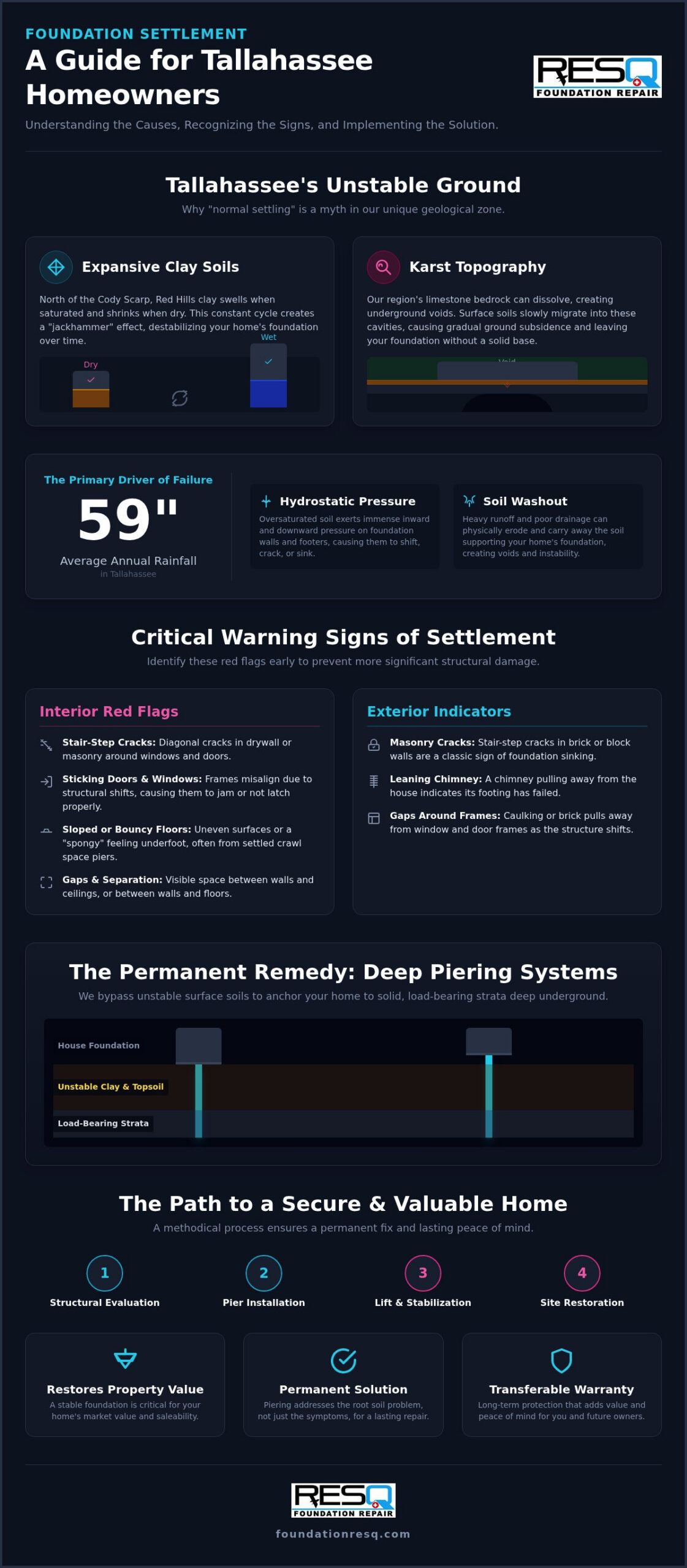
Tallahassee sits on a geological transition zone known as the Cody Scarp. North of this line, the Red Hills feature deep, clay-heavy soils. These clays are expansive, meaning they swell significantly when saturated and shrink during our dry periods. This constant cycle of expansion and contraction creates a “jackhammer” effect that destabilizes foundations over time.
Our region is also characterized by karst topography, where the underlying limestone is prone to dissolving and creating underground voids. While a sinkhole is a sudden and catastrophic collapse, localized ground subsidence is a much more common and slower process. This gradual sinking occurs when surface soils migrate into these limestone cavities, leaving your home without a solid base. We focus on reaching load-bearing strata, which are the deeper, more competent soil layers that remain unaffected by these surface-level changes.
Hydrostatic Pressure and Tallahassee’s Heavy Rain Cycles
Water is the primary driver of foundation failure in North Florida. When the ground becomes oversaturated, it exerts hydrostatic pressure against your foundation walls, often forcing them inward or causing them to sink. This saturation can also lead to a “washout” effect, where heavy runoff physically carries soil away from beneath your concrete slab or crawl space footers. Tallahassee’s 59-inch average annual rainfall accelerates settlement by constantly shifting the density and volume of the supporting earth. Without proper stabilization, this high volume of water will continue to erode the structural integrity of your home.
Critical Warning Signs of Foundation Settlement
Recognizing the early indicators of structural distress is vital for maintaining your home’s integrity. While some homeowners dismiss small cracks as minor settling, these symptoms often signal that the soil beneath your footers is shifting. Identifying these issues early can prevent the need for more invasive foundation settlement repair Tallahassee later. Following established foundation repair guidelines helps homeowners differentiate between cosmetic flaws and structural failure. Structural movement is rarely subtle once it begins, and the symptoms will manifest in both the interior and exterior of your property.
Interior Red Flags: From Drywall to Flooring
Drywall cracks often appear around the corners of doors and windows where the frame is under the most stress. If you notice a “stair-step” pattern in your interior masonry or drywall, the structure is likely sinking vertically. Gaps between the wall and the ceiling are another clear warning that the framing is pulling away from its original position. Many people assume sticking doors are caused by North Florida humidity. While moisture plays a role in wood expansion, a door that consistently rubs against its frame usually indicates a shifted foundation. You can check for floor slope by placing a level on the floor or observing if furniture seems to tilt toward a specific wall.
In many older Tallahassee homes with crawl spaces, “bouncy” or soft floors are a common complaint. This isn’t always a sign of wood rot; it often occurs when the interior masonry piers have settled into the clay soil. When these supports sink, the floor joists lose their level base, creating an uneven walking surface that feels unstable underfoot.
Exterior Indicators: Protecting Your Curb Appeal
Your home’s exterior often provides the most obvious clues of downward movement. In Tallahassee, where brick veneer is a popular choice, look for stair-step cracks in the mortar joints. These cracks follow the path of least resistance as the foundation drops. Gaps around garage doors or windows also suggest that the slab or footer is no longer level. Look for gaps in the frieze board, which is the trim where the siding meets the roofline. When a corner of the house sinks, this board will often pull away, leaving a visible opening that allows moisture and pests to enter.
One of the most dangerous signs is a separating chimney. Because chimneys are built on their own heavy footings, they often settle at a different rate than the rest of the house. If you see a gap between your chimney stack and the siding, the chimney’s base is likely failing. If you’ve noticed these signs, it’s a good idea to consult with a structural specialist to determine the exact cause of the movement before it worsens.
Permanent Remediation: Helical Piers vs. Push Piers
When surface soils fail, the only reliable remedy is to transfer the building’s weight to deeper, stable strata. Piering has become the professional standard for foundation settlement repair Tallahassee because it bypasses the unpredictable clays and karst voids that cause structural instability. While some contractors still offer “pressed” concrete piles, these often prove to be temporary fixes. Concrete piles rely on friction with the same unstable surface soil that caused the initial problem. In contrast, steel piering systems provide a permanent, mechanical connection to the earth’s load-bearing layers, ensuring your home remains level regardless of seasonal moisture changes.
Choosing the right piering system depends on the specific weight of your structure and the soil conditions on your property. Our team utilizes specialized technology to monitor torque and pressure during installation, providing verifiable proof that each pier has reached the required depth and capacity. This methodical approach is what distinguishes a professional Professional Helical Pier Installation from a quick, cosmetic patch.
Helical Piers: The Solution for Lighter Structures
Helical piers feature a screw-like mechanism with circular steel plates called helices. These are mechanically rotated into the ground using hydraulic equipment. This design allows them to “bite” into the soil, providing immediate stability without requiring the weight of a heavy building to drive them down. This makes them the ideal choice for lighter Tallahassee structures, such as porches, decks, or newer home additions that don’t have the mass of a full brick-and-mortar residence.
These piers are also highly effective in high-water-table areas, such as the southern parts of Leon County near the Woodville Karst Plain. Because they are screwed into the ground rather than pushed, they can be installed with minimal vibration. This protects the existing structure from further distress during the remediation process. They provide a high-capacity support system that remains unaffected by the “washout” effects common in our sandy or silty local soils.
Push Piers: Heavy-Duty Stabilization for Slabs
Push piers are the preferred choice for stabilizing heavy brick homes or large slab-on-grade residences. These systems use the existing weight of the building as leverage, with hydraulic rams “pushing” the steel pier sections through a bracket attached to your foundation’s footer. This process continues until the pier reaches a layer of soil or rock that can support the structure’s load. Push piers are driven deep until they hit bedrock or load-bearing soil.
By using the home’s own mass to test the pier’s capacity, we ensure that each point of support is capable of holding the structure’s weight. Once all piers are installed to the correct depth, the building can often be lifted back toward its original level position. This restoration of structural health not only stops further damage but also helps close the cracks in your walls and masonry that appeared during the settlement phase.
The Foundation Settlement Repair Process in Tallahassee
A successful structural remediation project follows a highly organized, engineering-based sequence. It isn’t a matter of guesswork; it’s a precise application of force and technology. For homeowners seeking foundation settlement repair Tallahassee, understanding these steps helps demystify the work being done around your property. The goal is always to move from a state of structural uncertainty to one of permanent stability. This methodical approach ensures that every pier performs its duty as a final line of defense for your home’s integrity.
Every project is unique to the specific geological conditions of the site. Whether your home sits on the clay-heavy Red Hills or the sandier soils south of the Cody Scarp, the process remains focused on reaching deep, competent strata. By following a problem-solution architectural pattern, we ensure that the symptoms of settlement are not just hidden, but fully resolved through professional stabilization.
Step 1: The Expert Structural Evaluation
The process begins with a comprehensive assessment of the building’s current state. Our technicians utilize advanced laser levels to map foundation elevations across the entire footprint of the home. This data allows us to identify specific “dips” where the soil has failed. We also conduct a thorough inspection of the crawl space to check for secondary damage, such as shifted masonry piers or moisture-related issues. For a deeper look at what to expect during this phase, you can consult our Tallahassee Foundation Repair Guide.
Once the evaluation is complete, we develop a customized remediation plan. This plan specifies the exact location and type of piers required to reach competent soil. Before any work begins, we mark all underground utilities and prepare the site to ensure the safety of our crew and your property. This preparation phase is vital for a smooth, efficient installation day.
Step 2: Installation and Final Stabilization
Installation starts with small, targeted excavations at each pier location to expose the foundation footer. We take great care to minimize the impact on your landscaping, often hand-digging these areas to preserve your plants and turf. If your project involves managing large root systems near the foundation, you can learn more about Precision Tree Company to see how professional arborists approach tree health and property safety. Once the footer is prepared, heavy-duty steel brackets are attached. Hydraulic jacks then drive the pier sections deep into the earth. We monitor the pressure constantly to ensure each pier reaches the necessary load-bearing strata.
The final phase is the most critical: the controlled lift. We use a synchronized hydraulic system to apply upward pressure, carefully raising the foundation toward its original level position. This process is done slowly to allow the home’s framing to adjust, which often helps close existing drywall cracks and restores the operation of sticking doors. After the structure is stabilized, the excavation sites are backfilled and compacted. We leave your property clean, with the structural health of your building fully restored. If you suspect your home is shifting, you should request a professional structural inspection to protect your investment.
Why Tallahassee Homeowners Trust Foundation ResQ
Foundation ResQ operates as a steadfast local expert with deep roots in the Florida Panhandle. We understand the specific environmental challenges of our region, from the shifting clays of the Red Hills to the limestone voids mentioned in previous sections. We combine this specialized regional knowledge with world-class engineering resources and industry best practices. We exclusively use permanent, American-made steel piering systems because they provide the durability required for foundation settlement repair Tallahassee. Our team doesn’t rely on quick fixes; we focus on methodical, long-term stabilization that protects your home’s structural integrity. To ensure your investment is fully secured, we provide transferable long-term warranties that offer peace of mind for you and any future owners of your property.
Our role is to act as a protector of the home, providing a reliable barrier between your structure and the unpredictable North Florida elements. We believe in transparency and thoroughness, ensuring that every homeowner understands the technical aspects of the remedy we provide. This commitment to professional integrity is why we’re a trusted name in structural remediation across Leon County. We take our duty seriously, focusing on outcomes that restore safety and lasting value to every building we service. By choosing a partner that understands the local geology, you’re ensuring that the stabilization is designed to last for the life of the structure.
Combining Foundation Repair with Moisture Control
Structural failure rarely happens in a vacuum. In many cases, foundation settlement goes hand-in-hand with significant crawl space issues. When a foundation sinks or shifts, it can create new pathways for moisture to enter the home’s substructure. Our holistic approach to home health often involves Crawl Space Encapsulation Tallahassee to seal out the humid Florida air and prevent wood rot. We also install high-performance sump pump systems and crawl space dehumidifiers as a secondary line of defense. These systems work in tandem to maintain a dry, stable environment, which is essential for preventing the soil moisture fluctuations that trigger settlement cycles.
A Commitment to Tallahassee Structural Health
Our mission is to protect and restore the structural health of every local home we enter. If structural settlement has allowed water intrusion to persist, mold growth often follows, creating a secondary threat to your family’s safety. To address this, we provide Professional Mold Remediation Tallahassee FL as part of our comprehensive service offerings. By resolving the root cause of the settlement and cleaning up the resulting environmental damage, we ensure your home is both structurally sound and healthy to live in. We’re dedicated to providing a complete resolution that addresses the health of the entire building footprint.
Securing Your Tallahassee Home’s Structural Future
Foundation ResQ provides the peace of mind you deserve through custom-engineered helical and push pier systems. As local experts familiar with the specific soil conditions of Leon County, we deliver remedies backed by the national strength of the Groundworks network. Every project includes a transferable warranty, ensuring your home remains a safe and stable asset for years to come. Don’t let structural uncertainty linger while the soil continues to shift. You can Schedule Your Free Foundation Inspection with Foundation ResQ today to receive a professional evaluation and a clear path toward a permanent resolution. Your home is your most important investment, and it’s our duty to help you protect it.
Frequently Asked Questions
How much does foundation settlement repair cost in Tallahassee?
The total cost of structural remediation depends on the number of supports required and the specific soil conditions on your property. Every home in Leon County presents unique challenges that require a professional evaluation to determine the necessary scope of work. We focus on providing a permanent remedy that protects your home’s value and prevents the need for repetitive, costly repairs in the future.
Will foundation repair stop my house from settling forever?
Yes, professional foundation settlement repair Tallahassee will permanently stop the downward movement of your home when done correctly. By installing steel piers that reach deep, load-bearing strata, we bypass the unstable surface clays that cause shifting. This mechanical connection to stable earth ensures the structure remains level regardless of seasonal moisture changes, providing a lasting solution for your property’s structural health.
Is foundation settlement covered by homeowners insurance in Florida?
Standard homeowner’s insurance policies in Florida generally don’t cover damage caused by gradual soil movement or settlement. Coverage is typically reserved for sudden, catastrophic events like a burst pipe or a covered fire. Because settlement is often considered a maintenance issue related to local geology, most homeowners pay for these structural restorations out of pocket or through specialized financing options.
Can I sell a Tallahassee home with foundation settlement issues?
You can sell a home with foundation issues, but Florida law requires you to disclose any known structural defects to potential buyers. Addressing the problem before listing the property is often the best strategy for a successful sale. Providing a transferable warranty from a reputable company restores buyer confidence and ensures that the structural integrity of the home is no longer a point of negotiation.
How long does the helical pier installation process take?
A typical residential piering project in Tallahassee takes between one and three days to complete. Most homes require the installation of 4 to 12 piers, which can be driven and stabilized relatively quickly by an experienced crew. We work efficiently to minimize disruption, and since the majority of the work happens outside the home’s footprint, your daily routine remains largely unaffected during the process.
Do I need to move out of my house during foundation repair?
You don’t need to move out of your house during the foundation repair process. The installation of helical or push piers is primarily an exterior operation that doesn’t affect the interior living space. While you may hear some noise from the hydraulic equipment and see technicians working around the perimeter of your home, the interior remains fully accessible and safe for your family throughout the project.
What is the difference between settling and a sinkhole in Tallahassee?
Foundation settlement is the gradual vertical movement of a structure into shifting surface soils, such as the expansive clays found north of the Cody Scarp. A sinkhole is a more sudden and localized collapse caused by the dissolution of underlying limestone. While both involve soil movement, settlement is a chronic condition that requires deep-earth piering to stabilize the home’s weight against the earth.
Can foundation cracks be fixed without piers?
While minor cosmetic cracks can be patched with epoxy or polyurethane, these methods don’t address the root cause of structural settlement. Without the support of a piering system, the home will continue to shift as the soil expands and contracts. Addressing drainage issues can slow the process, but steel piers remain the only definitive way to permanently stabilize a sinking foundation and prevent future damage.