Your home’s foundation shouldn’t be a source of constant anxiety, yet Florida’s unique geology often makes every crack in the drywall feel like a ticking clock. When you’re facing shifting ground or the risks of Tallahassee’s karst topography, the technical debate of helical piers vs push piers for Florida soil can feel like a maze of jargon. You’ve likely heard conflicting advice about which system is better, and the fear of investing in a repair that fails within a few years is a valid concern.
We understand that you’re looking for more than a quick fix; you need a permanent structural remedy that protects your home equity for the long haul. This guide breaks down the critical differences between these two systems so you can make an informed decision with confidence. We’ll look at how the upcoming 9th Edition of the Florida Building Code impacts these choices and help you determine which method provides the stability your specific property needs to stay level and secure. By matching the right pier system to your soil’s load-bearing strata, you can ensure your home remains a safe haven for decades to come.
Key Takeaways
- Understand the fundamental mechanical differences between torque-driven helical systems and weight-reliant push piers to ensure a permanent structural remedy.
- Discover how to navigate the choice of helical piers vs push piers for Florida soil by matching your home’s specific weight to the local geological strata.
- Learn why North Florida’s expansive red clay and high water table require specialized pier solutions to prevent future shifting.
- Identify which pier type serves as the proper restoration method for your specific structure, from lightweight porches to heavy masonry homes.
- Gain confidence in the installation process, moving from a forensic inspection to a stable foundation that protects your home equity.
Helical Piers vs. Push Piers: Understanding the Basics for Florida Foundations
Underpinning is the professional process of bypassing unstable surface soils to transfer a building’s structural weight onto deeper, load-bearing strata. In Florida, where the ground can shift due to high water tables or sinkhole activity, this process is essential for long-term stability. By Understanding Deep Foundations, homeowners can better visualize how these systems act as a protective barrier between their property and the volatile earth below.
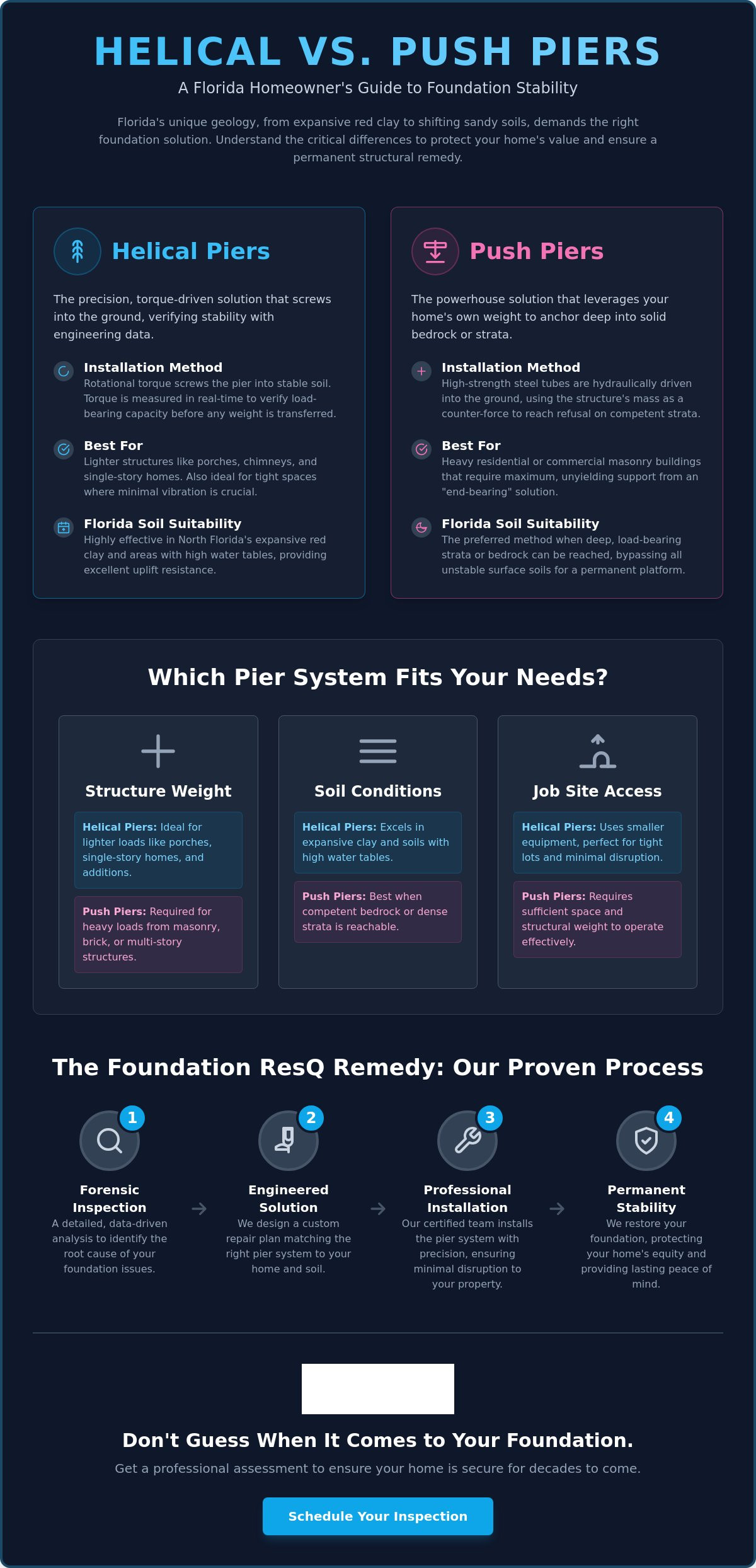
The technical distinction between helical piers vs push piers for Florida soil lies in their installation mechanics. Helical piers rely on rotational torque to “screw” into the earth; conversely, push piers utilize the existing weight of your home as a counter-force for hydraulic driving. Choosing the wrong system often leads to recurring settlement, which is why a professional structural assessment is the first step in any dependable remedy. A one-size-fits-all approach simply doesn’t account for the regional geological variety found across the state.
Florida’s environment is too unpredictable for guesswork. Whether you’re dealing with the sandy shores of the coast or the inland clay, the goal is always the same: finding soil that won’t move. A professional evaluation determines exactly how deep your specific foundation needs to go to find that stability.
What are Helical Piers?
Helical piers feature circular steel plates, known as helices, welded to a central shaft. These plates allow the pier to be screwed into the ground like a corkscrew, providing excellent uplift resistance against shifting soils. This system is a versatile choice for both new construction and the remedial foundation repair Tallahassee homeowners frequently need. During installation, our experts monitor the torque levels to verify that each pier has reached the specific load-bearing capacity required for the structure. It’s a precise, engineered solution that works well even in areas with high water tables.
What are Push Piers?
Push piers consist of high-strength steel tubes that are driven deep into the ground using hydraulic jacks. Unlike helical systems, push piers use the actual mass of the house as a counterweight to force the piers down until they reach bedrock or competent strata. In the Florida Panhandle, this “end-bearing” solution is often the preferred method for heavy residential or commercial masonry buildings. It provides a stable, permanent platform that doesn’t rely on the skin friction of the soil, making it a reliable final line of defense for heavy structures that require maximum support.
Helical Piers: The Precision Solution for North Florida’s Red Clay
Tallahassee’s Red Hills region presents a different set of challenges than the sandy coastal plains found further south. While many homeowners worry about sinkholes, the more common threat to structural integrity in our area is the expansive nature of local red clay. Helical piers offer a precision-engineered solution that addresses these specific soil behaviors. Unlike other methods, helical systems don’t rely on the weight of the building to reach stable ground. This makes them the primary choice for lighter structures such as porches, chimneys, and single-story homes where the building’s mass isn’t sufficient to drive a push pier to the necessary depth.
When comparing helical piers vs push piers for Florida soil, the advantage of “pre-loading” is a significant factor for helical systems. During installation, the torque required to screw the pier into the earth is measured in real-time. This allows our team to verify the load-bearing capacity of each pier before any weight is actually transferred from the house. Because the equipment used for helical installation is generally smaller and produces minimal vibration, it’s an ideal remedy for tight lots in historic Tallahassee neighborhoods or Midtown where heavy machinery isn’t feasible. Adhering to professional foundation design standards ensures that every installation is backed by verified engineering data rather than guesswork.
Tackling the Tallahassee Red Hills Geology
North Florida clay is notorious for its ability to expand and contract with seasonal rains. During the wet season, the clay swells and exerts upward pressure on foundations; during dry spells, it shrinks and leaves gaps that cause settlement. Helix plates act like anchors, providing resistance against this “heaving” cycle by gripping the soil at depths where moisture levels remain constant. Helical piers penetrate through the volatile clay layers to anchor into the stable, load-bearing strata deep beneath the surface. This deep-seated stability is the only way to ensure a permanent fix in our regional environment.
Ideal Applications for Helical Systems
These systems are also highly effective when used in tandem with carbon fiber wall repair Tallahassee projects. While carbon fiber secures the vertical integrity of bowing walls, helical piers stabilize the base to prevent further movement. They are the preferred choice when soil boring logs indicate deep, soft deposits that require a “screw-in” anchor to achieve stability. If you’ve noticed cracks in your chimney or a pulling porch, a professional foundation assessment can determine if a helical system is the right remedy for your home’s specific needs.
Steel Push Piers: Leveraging Your Home’s Weight for Ultimate Stability
While helical piers excel in expansive clay and for lighter additions, heavier structures require a different mechanical approach to achieve permanent stability. Steel push piers, often referred to as resistance piers, utilize the actual mass of your building to drive high-strength steel sections deep into the earth. This system creates a direct vertical column of support that bypasses unstable surface layers entirely. By using the house as a counterweight, the piers are forced downward until they reach a truly stable, high-density soil layer or load-bearing strata.
The installation involves a synchronized hydraulic manifold system. Once the piers are seated against a competent soil layer, the manifold allows for a uniform, controlled lift of the foundation. This process is designed to restore the building to its original level while monitoring pressure gauges to verify that each pier has reached its required capacity. When evaluating helical piers vs push piers for Florida soil, the push pier stands out as the premier end-bearing solution for heavy masonry homes that need to reach deep, reliable support.
When is Your Home “Heavy Enough” for Push Piers?
The success of a push pier installation depends on the resistance provided by the building. If a structure is too lightweight, the hydraulic force will simply lift the house off its foundation before the pier can penetrate the soil to a sufficient depth. This is why lighter structures like porches or single-story wood-frame homes are better served by the helical systems discussed previously. Conversely, two-story brick homes and commercial buildings throughout Leon County provide the necessary ballast for a successful push pier installation. Foundation ResQ performs detailed load calculations to ensure your home has the sufficient weight to drive piers to the most stable strata available.
Push Piers and Florida’s Karst Topography
North Florida is famous for its karst topography, a geological feature where limestone sits beneath the soil surface. This limestone is often riddled with voids or soft spots, which contributes to regional sinkhole risks. Push piers are particularly effective in this environment because they provide a “point-load” solution. They are driven until they encounter the resistance of the limestone or extremely dense sand, creating a bridge over any unstable upper soil. To combat the high moisture levels and high water tables common in our region, we utilize galvanized steel. This protective coating ensures the piers remain a durable, long-term defense against corrosion, maintaining the structural health of your home for decades.
The Florida Homeowner’s Decision Matrix: Piers, Soil, and Depth
Deciding between helical piers vs push piers for Florida soil requires a methodical look at the intersection of structural weight and geological stratification. In our region, the presence of a high water table adds a layer of complexity that cannot be ignored. High moisture levels in the soil accelerate the corrosion of untreated steel; this is why we utilize high-quality galvanized coatings to ensure the longevity of every installation. While both systems provide a path to structural health, the final decision should always be rooted in data. Utilizing a geotechnical report allows us to see exactly what lies beneath your foundation, whether it’s soft organic muck or stable limestone. Investing in a permanent foundation repair solution means matching the mechanical advantage of the pier to the specific resistance of the soil.
To help you understand the variables, consider these primary factors in the decision-making process:
- Load Capacity: Push piers are designed for heavy concentrated loads; helical piers are better for lighter or distributed weight.
- Installation Depth: Push piers drive until they hit “refusal” at limestone or dense sand; helical piers stop when torque verifies capacity.
- Soil Compatibility: Helical piers “grip” loose sandy soil; push piers “pierce” through it to find bedrock.
Soil Type Comparison: Sand vs. Clay vs. Limestone
Sandy coastal soils often lack the immediate density required for push piers to find resistance. In these environments, helical piers act as a “screw anchor,” providing immediate grip even in loose deposits. In North Florida, the dense clays of the Red Hills can support either system, but the “Karst Factor” remains the primary variable in Leon County. If the limestone layer is relatively shallow, push piers provide a direct vertical column to that stable rock. If the limestone is hundreds of feet deep, helical piers can anchor into intermediate dense soil layers more effectively to provide a permanent remedy.
Structural Weight and Foundation Type
The footprint of your home also dictates the piering strategy. Slab-on-grade foundations often settle at the corners, while crawl space homes have unique vulnerabilities along the entire perimeter. Even if you have already completed crawl space encapsulation Tallahassee services, the perimeter footings still require deep piering if the underlying soil is shifting. We often implement a multi-stage remedy that combines perimeter piers with PolyRenewal concrete lifting for sinking interior slabs. This combination stabilizes the heavy exterior masonry while restoring the interior floors to a level, safe condition. If you’re unsure which system fits your home, schedule a forensic foundation inspection to get a clear, data-driven recommendation.
The Foundation ResQ Remedy: Professional Pier Installation
Foundation ResQ operates as the Steadfast Local Expert for homeowners across North Florida. We understand that structural integrity isn’t just about the hardware; it’s about the precision of the installation. Our process begins with a forensic inspection to identify exactly why your home is settling. We don’t guess. We analyze the soil, the building’s weight, and the local topography. This data-driven approach allows us to determine the right application of helical piers vs push piers for Florida soil, ensuring your home receives a permanent structural remedy rather than a temporary patch.
Foundation ResQ brings together unparalleled local expertise with a steadfast commitment to reliability in every project. Our installation process is methodical and thorough. Once the forensic data is gathered, we move to the stabilization phase. This involves excavating the footing, mounting heavy-duty brackets, and driving or screwing the piers to the verified load-bearing strata. We monitor every stage to ensure the results meet our professional standards. Your investment is protected by industry-leading warranties, providing you with the confidence that your home’s equity remains secure for the long haul.
Every home is unique, and our ability to utilize both helical and push pier systems allows us to provide a tailored remedy. We match the mechanical advantage of the piering system to the specific resistance of your property’s soil. This commitment to precision is what separates a professional restoration from a quick fix that might fail in a few years.
Beyond the Pier: A Holistic Approach to Foundation Health
Foundation stabilization is often just one part of a larger restoration project. Moisture control and proper drainage are vital post-piering to prevent future soil erosion or expansion around your new supports. In many cases, foundation issues lead to humidity problems or water intrusion that affects the air quality inside the home. Our mold remediation Tallahassee FL services complement our structural work by ensuring the interior environment is as healthy as the exterior is stable. We also recommend annual foundation monitoring to keep a professional eye on your home’s health as the Florida climate continues to shift.
Take the Next Step Toward a Stable Home
Taking the first step toward a stable home is straightforward and stress-free. During your structural consultation, an expert will walk through your property to identify signs of distress and explain the underlying causes. You’ll receive a clear, written plan for stabilization that outlines the exact remedy we recommend and why it fits your home’s footprint. This transparency ensures you aren’t left in a state of uncertainty about your most valuable asset. When you’re ready to protect your home’s future, Contact Foundation ResQ for a professional foundation assessment.
Secure Your Home’s Structural Future
Choosing between helical and push piers isn’t about finding a “better” product; it’s about selecting the right engineering remedy for your specific property. Whether you’re anchoring a lightweight porch into Tallahassee’s expansive red clay or driving heavy duty steel to the stable limestone layers of our karst topography, the goal is always permanent stabilization. Understanding the technical nuances of helical piers vs push piers for Florida soil empowers you to move from a state of uncertainty to one of informed confidence. Each system offers a distinct mechanical advantage that, when applied correctly, stops settlement in its tracks.
As a Groundworks family brand, Foundation ResQ combines national resources with the specialized local expertise needed to navigate North Florida’s unique geological challenges. We provide methodical, warrantied solutions that protect your home equity and ensure your building remains a safe haven for decades. Don’t let foundation settlement compromise your peace of mind. Schedule Your Free Foundation Inspection with Foundation ResQ today to receive a clear, professional plan for your home’s permanent restoration. We’re here to serve as your final line of defense against shifting ground.
Frequently Asked Questions
Which is better for Florida soil, helical piers or push piers?
Neither system is universally superior; the right choice depends on your home’s weight and the specific soil strata on your property. Helical piers are often the preferred remedy for sandy soils or lighter structures because they anchor into the earth like a screw. Push piers are generally better for heavy masonry homes that need to reach deep limestone or dense sand layers for end-bearing support. A professional forensic inspection is the only way to determine the correct application for your foundation.
How deep do foundation piers need to go in Tallahassee?
Installation depth in Tallahassee varies significantly due to our unique karst topography and the thick layers of the Red Hills clay. Piers typically reach depths between 20 and 70 feet, though some projects require driving steel over 100 feet to find competent load-bearing strata. Our team monitors torque or hydraulic pressure during every installation to ensure each pier reaches the specific depth required to provide permanent stability for your home’s structural load.
Can helical piers be installed in clay soil?
Yes, helical piers are exceptionally effective in the dense red clay found throughout North Florida. The helix plates are designed to screw through the volatile upper layers of expansive clay to anchor into more stable soil beneath. This design provides excellent resistance against “heaving,” which is the upward movement caused by clay expanding during our heavy rainy seasons. This makes them a reliable, precision-engineered solution for maintaining a level foundation in our regional geology.
Will push piers work for a single-story frame house?
Push piers are usually not the right choice for lightweight, single-story frame houses. These systems rely on the actual weight of the building to provide the resistance needed to drive the steel tubes deep into the ground. If the house is too light, the hydraulic force will lift the structure before the pier reaches stable soil. For these lighter residential buildings, we typically recommend helical piers as they don’t require the building’s mass for a successful installation.
Do foundation piers prevent future sinkhole damage?
Foundation piers provide deep structural support by reaching stable strata, but they aren’t a preventative measure for sinkholes. While they stabilize a home against standard soil settlement and shifting, a true sinkhole involves large-scale subterranean voids that require specialized geological remediation. Piers act as a final line of defense for the building’s integrity, but they don’t change the underlying karst conditions of the earth itself. We focus on providing a permanent remedy for structural settlement.
How long does it take to install a helical pier system?
Most residential helical pier projects are completed within two to four days. The timeline depends on the number of piers required and how easily our compact equipment can access the perimeter of your foundation. Because helical installation involves minimal vibration and smaller machinery, it’s a relatively clean process that doesn’t require massive excavation. This efficiency allows us to restore your home’s stability quickly while minimizing the overall disruption to your daily life and landscaping.
Are foundation piers covered by Florida homeowners insurance?
Standard Florida homeowners insurance policies generally don’t cover foundation repair caused by gradual soil settlement or erosion. However, if the structural damage is a direct result of a confirmed sinkhole and you have the required coverage, your policy might assist with the costs. It’s vital to review your specific policy and consult with your agent. We provide the detailed engineering documentation and PE-stamped plans you’ll need if you’re filing a claim for structural restoration.
What is the difference between a pier and a pile in foundation repair?
While people often use these terms interchangeably, there’s a technical distinction in the industry. “Piers” typically refer to the underpinning elements we use to support and lift existing foundations that have already begun to fail. “Piles” usually describe deep foundation components driven into the ground during the initial construction of a new building. When discussing helical piers vs push piers for Florida soil, we’re specifically talking about remedial systems designed to fix and protect established homes.