
Foundation damage is never static. A hairline fracture across your drywall or a sticking bedroom door isn’t just an isolated settling quirk; it is an active structural warning. Most homeowners naturally wonder what happens if you don’t fix foundation problems right away, often hoping that postponing action will spare them a stressful project and protect their immediate budget.
It’s completely understandable to hesitate. When you aren’t certain whether a hairline fissure signals genuine structural failure, waiting can feel like the safest choice. Yet ignoring early symptoms only gives shifting ground and moisture issues more time to compromise your home’s framing, plumbing lines, and overall safety.
In this guide, you’ll discover the progressive structural and financial consequences of putting off critical repairs, learn to distinguish cosmetic settling from active structural emergencies, and explore permanent stabilization methods engineered to halt movement. Here is a clear look at how foundation issues unfold over time, and how proactive care safeguards your home equity.
Key Takeaways
- Understand exactly what happens if you don’t fix foundation problems early, and how active soil shifting transfers dangerous stress directly into framing and roof systems.
- Identify how unchecked structural movement sparks cascading secondary damage, including sheared interior plumbing and chronic moisture intrusion.
- Discover the link between shifting crawl space footings, unmanaged humidity, and rampant wood rot or toxic mold growth beneath your floors.
- Learn why unresolved settling creates severe real estate roadblocks, from denied buyer financing to steep losses in home equity.
- Explore permanent, engineered remediation methods like helical piers and carbon fiber reinforcement that halt movement and restore structural stability.
The True Cost of Waiting: How Minor Settlement Becomes Structural Failure
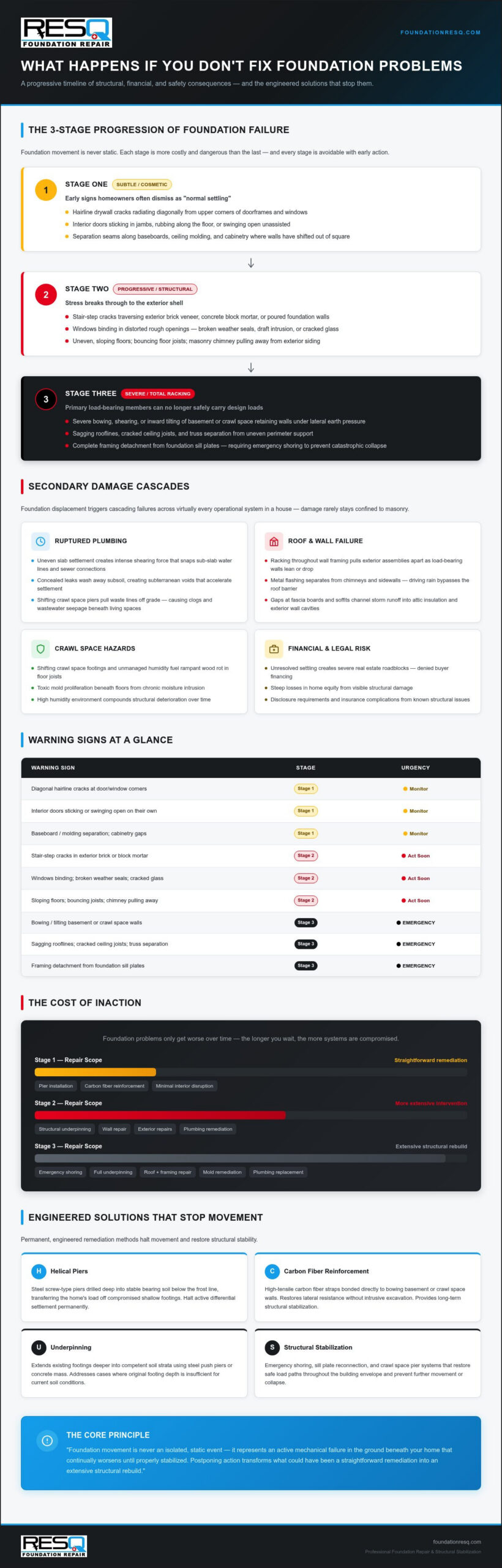
Foundation movement is never an isolated, static event; it represents an active mechanical failure in the ground beneath your home that continually worsens until properly stabilized. Differential settlement permanently compromises a home’s structural envelope by shifting load paths away from designed footings and twisting the framework above. Understanding what happens if you don’t fix foundation problems begins with recognizing this mechanical progression. When soils shift, settling stress transfers upward through sill plates, wall studs, and roof rafters. Postponing action transforms what could have been a straightforward remediation into an extensive structural rebuild.
The progression moves through three distinct phases as mechanical stress accumulates throughout the building envelope.
Stage One: Subtle Cosmetic Indicators Homeowners Often Dismiss
Early structural movement creates minor, visible distortions that homeowners frequently mistake for seasonal building adjustments:
- Hairline drywall cracks radiating diagonally from the upper corners of doorframes and windows.
- Interior doors that suddenly begin sticking in their jambs, rubbing along the floor, or swinging open unassisted.
- Separation seams appearing along baseboards, ceiling molding, and kitchen cabinetry where walls have shifted out of square.
Stage Two: Progressive Mechanical and Exterior Structural Displacement
As the footing sinks deeper into unstable soil, stresses break through interior finishes to impact the exterior shell:
- Stair-step cracks traversing exterior brick veneer, concrete block mortar, or poured foundation walls.
- Windows binding tightly within distorted rough openings, leading to broken weather seals, draft intrusion, or cracked glass panes.
- Uneven, sloping floors inside the home, paired with bouncing floor joists and visible separation where the masonry chimney pulls away from the exterior siding.
Stage Three: Severe Structural Compromise and Total Racking
Without intervention, continuous movement compromises the fundamental stability of the entire property. In engineering terms, this stage represents the edge between active structural integrity and failure, where primary load-bearing members can no longer safely carry design loads. Symptoms at this stage include:
- Severe bowing, shearing, or inward tilting of basement or crawl space retaining walls under excessive lateral earth pressure.
- Sagging rooflines, cracked ceiling joists, and truss separation triggered by uneven perimeter support.
- Complete framing detachment from foundation sill plates, requiring complex emergency shoring and underpinning to prevent catastrophic collapse.
Addressing these warning signs early with engineered foundation systems prevents superficial shifts from deteriorating into total structural failure.
Secondary Disasters: Damage Caused by Unchecked Foundation Movement
When concrete footings shift, the consequences rarely stay confined to masonry. Foundation displacement triggers cascading secondary failures across virtually every operational system in a house. Understanding what happens if you don’t fix foundation problems means recognizing that structural movement acts like a slow tectonic shift, straining plumbing, tearing roof assemblies, and breaking the building’s protective envelope.
Ruptured Plumbing and Slab Leaks
Cast iron and PVC pipes lack flexibility under dynamic load shifts. When a concrete slab settles unevenly, the intense shearing force snaps sub-slab water lines and sewer connections. Concealed leaks then wash away underlying subsoil, creating expansive subterranean voids that accelerate settlement. In crawl spaces, shifting piers pull waste lines off grade, causing sluggish drainage, recurring clogs, and persistent wastewater seepage directly beneath living spaces.
Roof Leaks, Flashing Tears, and Wall Separation
Racking throughout the wall framing pulls exterior assemblies apart. As load-bearing walls lean or drop, metal flashing separates from chimneys and adjoining sidewalls, allowing driving rain to bypass the roof barrier. Gaps form at fascia boards and soffits, channeling storm runoff directly into attic insulation and exterior wall cavities. Masonry chimneys that tilt outward create wide apertures that funnel moisture behind brick veneer and wood siding.
Compromised Home Security, Energy Loss, and Pest Ingress
Structural shifting warps perimeter openings, altering everyday safety and efficiency:
- Square doorframes twist into parallelograms, misaligning strike plates so deadbolts cannot engage properly.
- Fissures through stem walls and slabs grant subterranean termites, carpenter ants, and rodents effortless passage into wall cavities.
- Perimeter gaps around displaced sill plates allow conditioned air to escape, spiking monthly utility bills by overworking heating and cooling systems.
To avoid these compounding structural and utility failures, restoring footing stability according to building code standards for professional foundation repair is essential. Scheduling a thorough structural assessment with Foundation ResQ helps secure vulnerable framing, protect utility connections, and stop active damage throughout your home.
Crawl Space Hazards: Rot, High Humidity, and Toxic Mold Proliferation
Foundation movement in homes with raised foundations rarely happens in a dry environment. In crawl spaces, settling footings almost always correlate with severe moisture imbalance beneath the structure. Understanding what happens if you don’t fix foundation problems in these environments means examining the damp ecosystem under your subfloor. Unsealed ground and poor drainage allow moisture to saturate structural timbers, creating an ideal breeding ground for microbial growth and wood decay.
The Stack Effect: How Crawl Space Air Enters Your Living Space
Natural building physics dictates that warm air rises through your home and escapes through the attic. This upward airflow creates negative pressure on the ground floor, pulling roughly half of your first-floor breathing air directly from the crawl space. When that below-ground air carries elevated humidity, fungal spores, and musty odors, indoor air quality degrades quickly. Microscopic spores circulate through air ducts, settle into carpets, and can trigger chronic respiratory irritation for sensitive household members.
Subfloor Wood Rot and Sagging Floor Systems
When relative humidity in an enclosed crawl space consistently exceeds 70 percent, wood-destroying fungi thrive. Saturated floor joists, rim joists, and main carrying beams soften, losing their ability to support the weight of interior walls and furniture above. Left unaddressed, damp wood rots, floors sag underfoot, and perimeter baseboards pull away from finished walls. Installing specialized crawl space encapsulation Tallahassee systems creates a heavy-duty vapor barrier that isolates damp soil, controls relative humidity, and stops timber rot at the source. If active fungal colonies have already colonized damp subfloor framing, professional mold remediation Tallahassee FL cleanses contaminated surfaces under strict containment protocols before repairs proceed.
Regional Soil Instability in North Florida
Local geology plays a major role in crawl space movement. Tallahassee red clay possesses high shrink-swell capacity, expanding forcefully when saturated by heavy subtropical downpours and shrinking rapidly during dry spells. This cyclical soil expansion creates immense lateral hydrostatic pressure against masonry foundation walls. Over time, that exterior force pushes concrete blocks inward, resulting in horizontal cracking and compromised stem walls. Implementing carbon fiber wall repair Tallahassee permanently locks bowing masonry walls in place, distributing lateral earth pressures across bonded composite straps to prevent catastrophic wall failure.
Financial and Legal Ramifications: Property Value, Insurance, and Sale Roadblocks
Unaddressed foundation movement represents more than an isolated engineering defect; it is an active liability that systematically dismantles home equity. Mandatory seller disclosure laws require homeowners to formally report known structural movement and past remediation, making unaddressed foundation problems impossible to legally conceal during a transaction. Understanding what happens if you don’t fix foundation problems from a financial standpoint clarifies why delaying action creates severe obstacles to selling, insuring, and refinancing your property.
Severe Diminution of Real Estate Resale Value
When structural movement appears on an inspection report, retail buyer interest drops sharply. Prospective buyers routinely demand steep price concessions that far exceed the actual cost of engineering repairs to buffer their own risk. Properties showing visible cracking or unlevel floors linger on the market, frequently forcing owners to accept drastic discounts from cash investors after conventional deals fall apart.
Financing and Insurance Underwriting Disqualifications
Mortgage underwriters enforce strict physical standards before approving purchase or refinance loans. Appraisers evaluating properties for FHA, VA, and conventional lending programs must flag active settlement, cracked masonry, and shifted footings, which halts the loan approval process until repairs are completed. Furthermore, standard property insurance policies specifically exclude damage caused by earth movement and settlement. If foundation shifting snaps internal pipes or buckles walls, insurance carriers routinely deny coverage under standard earth-movement exclusions.
Exponentially Escalating Construction and Remediation Costs
Delaying repairs allows localized soil movement to evolve into an extensive, multi-trade reconstruction project:
- Early intervention with targeted push or helical piers isolates movement at the footing before framing distorts.
- Waiting years compounds structural damage, requiring secondary framing realignment, finish repairs, and sub-slab plumbing re-piping.
- Preventative stabilization costs substantially less than emergency structural reconstruction after load paths fail.
Protect your equity and secure your property value before minor settling escalates into an unsellable asset. Schedule a professional structural evaluation to diagnose your foundation’s load-bearing capacity and implement lasting stabilization.
Engineered Solutions: How Professional Foundation Repair Restores Structural Integrity
Stabilizing a shifting foundation doesn’t require tearing down your home or pouring an entirely new slab. Modern foundation restoration utilizes advanced, non-invasive engineering systems specifically calibrated to counteract unstable subsoils. Homeowners investigating what happens if you don’t fix foundation problems quickly realize that targeted, early stabilization protects framing and halts settlement permanently. Exploring our detailed guide to foundation repair Tallahassee provides valuable clarity on matching the right engineering system to your property’s specific soil conditions.
Underpinning with Helical Piers and Heavy-Duty Push Piers
When upper soil strata can no longer support structural weight, foundation underpinning transfers building loads directly to dense, load-bearing strata. Hydraulically driven push piers utilize the structural mass of the home itself to drive rugged steel pier sections deep into stable soil layers or solid bedrock. In lighter additions or varied soil conditions, specialized helical pier installation mechanically drives steel screw-piles to reach predetermined load capacities. Both systems establish permanent stability and can often lift settled walls back toward their original positions.
Wall Reinforcement and Precision Concrete Lifting
Inward-bowing masonry walls caused by heavy lateral earth pressure require reinforcement before they shear at the joints. Aerospace-grade carbon fiber straps bond directly to block or poured concrete walls with high-strength epoxy, locking them in place without intrusive yard excavation. For sunken walkways, garage aprons, and interior slabs, high-density PolyRenewal polyurethane foam expands underneath sinking concrete to fill voids and restore proper grades. Explore how concrete leveling Tallahassee quickly eliminates trip hazards and prevents rainwater from pooling near foundation walls.
Comprehensive Moisture Control and Professional Inspection
Long-term structural resilience requires managing the moisture environment that causes soil shifting in the first place:
- Interior drain systems intercept groundwater around footings and direct it to heavy-duty sump pump systems for exterior discharge.
- Dedicated crawl space dehumidifiers keep ambient relative humidity consistently below levels that foster timber-destroying rot.
- Routine inspections verify that soil conditions, moisture levels, and load points remain properly balanced over time.
Don’t wait to see what happens if you don’t fix foundation problems until framing separates and repair complexity multiplies. Contact Foundation ResQ to schedule a methodical structural evaluation and secure your home’s foundation with certified engineering solutions.
Protect Your Home and Equity Before Movement Escalates
Ignoring early signs of settlement doesn’t make structural shifts disappear. Understanding what happens if you don’t fix foundation problems highlights a fundamental reality: minor ground movement inevitably cascades into cracked walls, separated framing, and significant equity loss. When you stabilize footings early, you protect your entire living space from costly secondary damage.
Targeted engineering solutions like steel piers, carbon fiber reinforcement, and moisture management systems stop shifting soils from threatening your structure. Backed by industry-leading engineering standards and extensive experience with Tallahassee red clay and coastal plain soils, our team delivers dependable, permanent stabilization. You don’t have to navigate structural uncertainty alone. Take control of your home’s long-term safety today. Schedule a comprehensive structural inspection with Foundation ResQ to secure your foundation and preserve your peace of mind.
Frequently Asked Questions
Can a house collapse if foundation problems are not fixed?
Total structural collapse is rare in modern construction, but partial collapses and severe structural failures happen frequently if settlement continues unchecked. Over time, framing pulls away from foundation footings, load-bearing masonry walls buckle under lateral earth pressure, and roof trusses lose essential perimeter support. In extreme cases, localized wall or floor collapses force municipal building officials to condemn the home until certified underpinning stabilizes the structure.
Is it safe to live in a house with foundation problems?
Safety depends on the severity of the structural movement, but living with active foundation damage introduces ongoing health and safety hazards. Minor early settling rarely poses an immediate structural hazard. However, advanced movement jams egress doors, breaks window glass under frame stress, and fractures concealed utility lines. In Tallahassee homes with crawl spaces, unaddressed shifting often accelerates moisture intrusion and toxic mold growth, degrading indoor air quality.
Does homeowners insurance cover damage caused by foundation settlement?
Standard homeowners insurance policies do not cover foundation damage caused by settling, earth movement, or shifting soil. Insurers view soil-related settling as routine maintenance and general wear. Coverage generally only applies if foundation damage stems directly from a sudden, covered peril, like an abrupt interior pipe burst. Homeowners exploring what happens if you don’t fix foundation problems should realize that repair costs remain their financial responsibility.
Can I sell a home with unfixed foundation problems in Florida?
Yes, you can legally sell a home with foundation problems in Florida, but state disclosure laws require full transparency regarding known structural defects. Florida sellers must complete formal property disclosures detailing known movement, cracks, or water intrusion. Unrepaired defects typically disqualify prospective buyers using conventional, FHA, or VA financing. Consequently, properties with active structural issues usually sell only to cash investors at steep discounts below market value.
How quickly do foundation problems get worse if ignored?
The rate of foundation deterioration varies based on weather, but structural movement accelerates rapidly during wet seasons and prolonged droughts. In Tallahassee, expansive red clay soils swell during heavy subtropical rains and shrink during dry spells. This cyclical expansion and contraction places dynamic stress on footings. What starts as a slow seasonal shift can turn into severe framing displacement within a single heavy storm season once load paths move off center.
What happens to plumbing pipes when a foundation settles?
Settling foundations place immense shearing stress on rigid plumbing lines, often snapping pipes beneath concrete slabs or inside crawl spaces. When a concrete footing drops or a crawl space pier shifts, rigid PVC and cast iron pipes cannot bend to accommodate the movement. Supply pipes break and waste lines lose proper pitch, causing concealed under-slab leaks or crawl space flooding. These hidden leaks wash away surrounding subsoil, accelerating structural settlement even further.
Can cosmetic repairs like patching drywall hide foundation issues?
Patching drywall or caulking trim gaps only conceals cosmetic symptoms temporarily; it does nothing to correct underlying structural movement. Spackle and fresh paint provide short-term visual relief, but they cannot stop active soil shifting. Within weeks or months, continued ground movement re-cracks the repaired seams, binds interior doors again, and worsens framing misalignment. Understanding what happens if you don’t fix foundation problems means recognizing that superficial cosmetic fixes leave underlying structural risks unresolved.